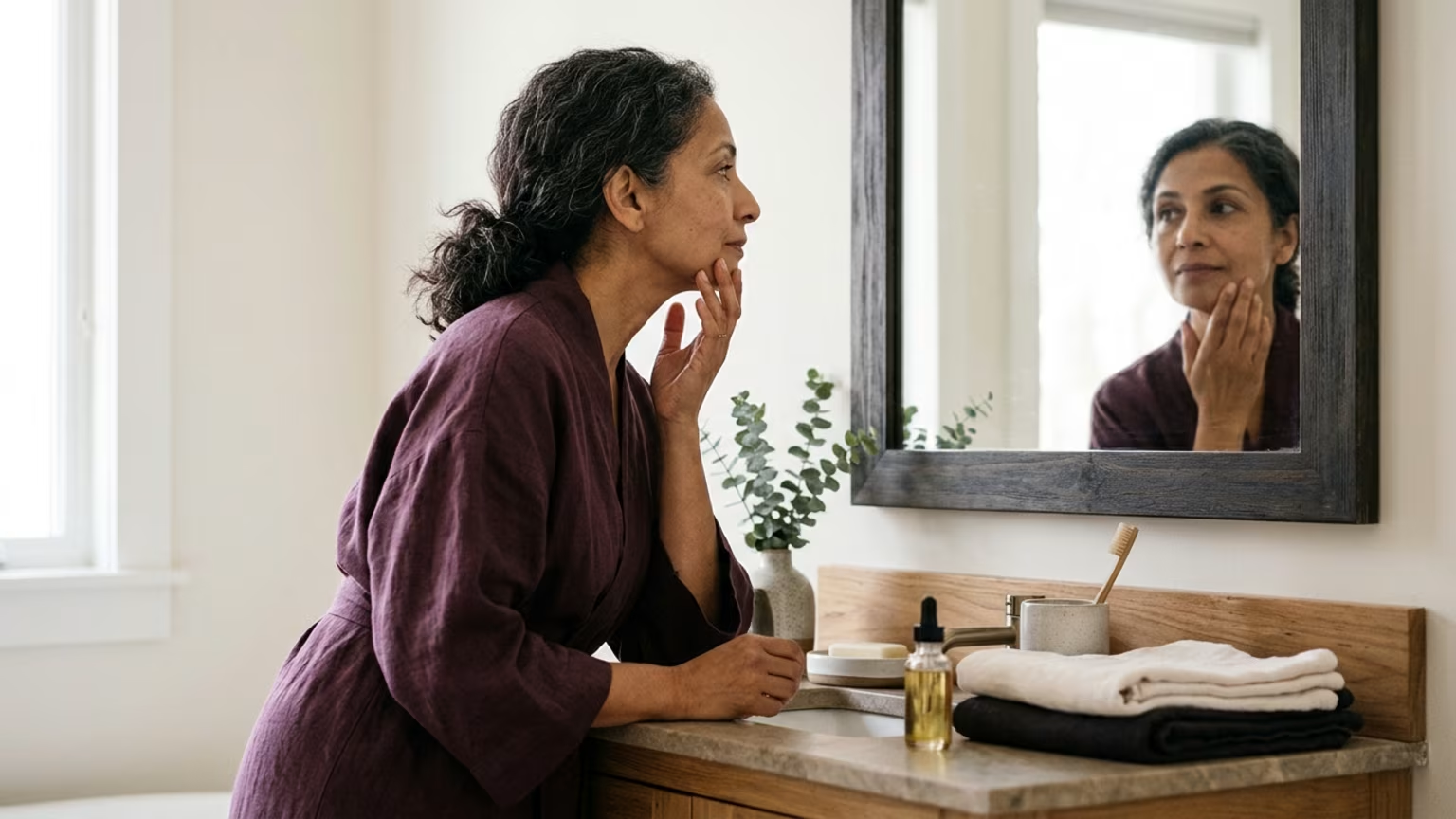

Learn how menopause, age and sun exposure shape midlife skin, what helps with dryness, and how to track changes without assuming they’re hormonal.





Menopause can contribute to drier, thinner or less firm skin, but it is only one influence on how your skin changes in midlife.
Dryness fits with the hormonal changes of menopause. The American Academy of Dermatology (AAD) says skin may lose some of its ability to hold water during this transition. The AAD also describes thinner skin and a loss of firmness among the changes that can occur around the same time.
These are distinct changes. Dryness is something you may notice in how your skin feels, while firmness is a different quality. A dry patch is not a measure of how thin your skin has become, and a new line does not tell you how well your skin is holding water.
That distinction matters more for day-to-day care than finding one name for everything that has changed. If dryness is what bothers you, it makes sense to give it attention on its own rather than treating it as part of a wider appearance problem you need to solve.
Collagen loss is one part of the explanation. The AAD reports that studies estimate women lose about 30% of their skin collagen during the first five years of menopause. The reported decline is slower after that, at about 2% annually for the next 20 years.
Those figures describe estimates of collagen loss, not how much firmness any one person will notice. They are not a timetable for when a line will appear or a way to judge how quickly your face is changing. There is no useful comparison between a percentage from a study and what you see in the mirror.
If you’re noticing a shift in firmness, that can be a more useful description than saying your skin has suddenly aged. It names the feature you’re paying attention to without turning it into a verdict on your appearance. Refemina’s guide to collagen and skin structure in midlife takes a closer look at that part of the picture.
Age-related skin changes and the hormonal transition overlap, and the evidence does not neatly separate their effects. The AAD says genes have a large influence on when age-related changes appear. It also identifies sun protection and stopping smoking as ways to reduce premature skin aging.
That overlap is why the timing of a change is a clue, not an explanation. Noticing a line during menopause tells you when it caught your attention. It does not assign a share of that change to hormones, age or past sun exposure. A change in skin colour and a change in firmness need not have the same explanation just because you noticed them together.
This is also why comparisons with other women can be misleading. The timing of someone else’s skin changes offers little guidance on what you should expect to see. For more context, Refemina looks at the influences on midlife skin beyond hormones.
The AAD’s suggestions start with the parts of skin care you already use: cleansing and moisturizing. It recommends a mild cleanser rather than soap, and applying moisturizer after bathing and when your skin feels dry. The aim of this advice is to care for dryness, not to reverse every skin change that happens around menopause.
It helps to keep that aim specific. If you’re paying attention to how dry your skin feels, use that as the point of comparison rather than looking for a change in lines or firmness. You may care about both, but they are different questions to ask of the same routine.
A patch that feels rough can make exfoliation seem like the obvious next step. The AAD cautions that skin can thin during menopause and recommends talking with a dermatologist before trying exfoliation or microdermabrasion at home. If you want to keep the basics in view, Refemina has a guide to building a manageable skin care routine in midlife.
Yes. Cumulative sun exposure can contribute to age spots and darker areas of skin, according to the AAD. That makes sun protection relevant whether or not you’re also noticing dryness or a change in firmness. The AAD recommends daily broad-spectrum sunscreen with SPF 30 or higher on skin that clothing does not cover.
Think of sun protection and moisturizing as serving different purposes. Sunscreen helps limit further sun-related damage, while moisturizer is part of the AAD’s advice for dryness. Neither choice requires you to work out what caused the changes you already see. If a particular spot is changing, that is a separate concern to bring to a dermatologist rather than assuming it is an age spot.
Keep a brief record of the change you actually want to follow. A note can be enough. The point is to make a later comparison easier, not to turn your skin into a daily project.
A log like this is a practical observation tool, not a test of what hormones are doing. Its value is in the details you can refer to later. If you bring a concern to an appointment, you have more to go on than a recollection that something seemed different around the time of menopause.
There is no need to wait for a better photo or a longer record before asking about a changing spot or dryness that persists. The AAD recommends discussing persistent dryness with a dermatologist and asking about skin cancer screening, including how often to do skin self-exams. An occasional photo for comparison serves a different purpose from a skin self-exam.
Menopause can help explain why skin feels drier or looks less firm, but the change itself is a better starting point for care than an assumption about its cause.
Everyday skin care choices belong to the woman making them; Refemina puts those choices in the context of midlife without making younger-looking skin the goal. For readers weighing whether dryness or a shift in firmness is hormonal, its reporting explains where hormones fit and where age, sun exposure and other influences also matter.

Follow Refemina for research-led insights on menopause, strength, metabolism, nutrition, skin, intimacy and confidence through midlife. New articles turn complex topics into clear, useful context.





Keep learning about the changes that shape energy, strength, confidence and wellbeing through midlife.
Explore Resources