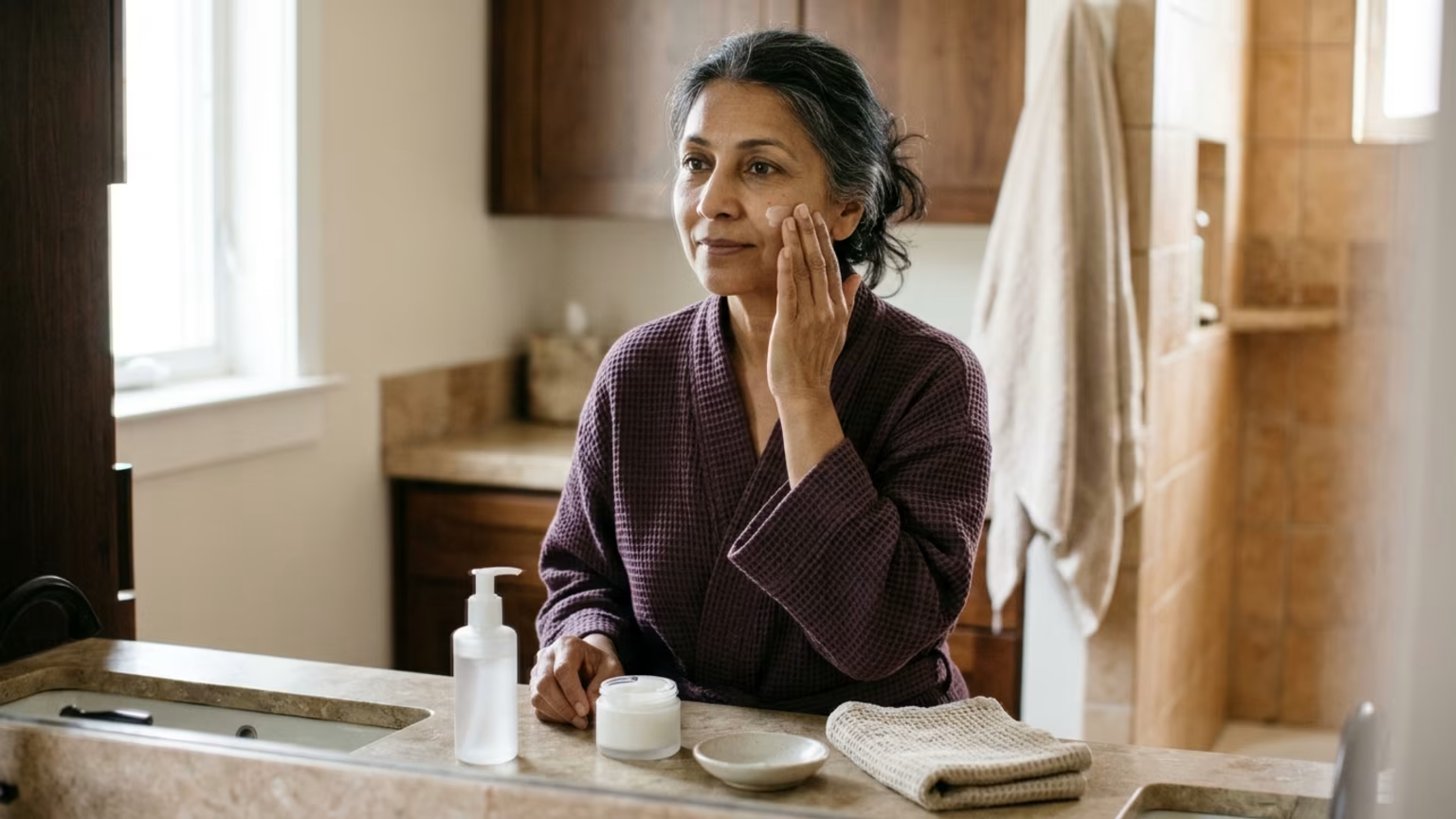

A practical menopause skincare routine for drier or more sensitive skin, with guidance on the basics and when to discuss an optional retinoid.





When skin feels drier or more sensitive during menopause, the choice is whether gentle cleansing, moisturising and sun protection meet your needs or whether a specific concern warrants discussing a retinoid.
The American Academy of Dermatology (AAD) recommends a mild cleanser, moisturiser when skin feels dry and daily broad-spectrum sunscreen with SPF 30 or higher. Together, those steps address everyday care without asking every product to do the same thing. Gentle cleansing and regular moisturising support the skin barrier, an approach also recommended in a 2026 review of inflammatory skin conditions. Sunscreen has a separate job: sun protection.
The AAD notes that skin can become drier and more sensitive during menopause. Its advice is to use a mild cleanser instead of soap. If cleansing is the part of your routine you find uncomfortable, that is a useful place to look before shopping for something to layer on afterwards.
The point is to make an everyday step gentler. That might be the only change you want to start with. A menopause-aware routine can be an adjustment to what you already use, not a reason to replace everything at once.
The AAD recommends moisturising when skin feels dry and choosing a fragrance-free moisturiser to reduce irritation. It also points to hyaluronic acid or glycerin as ingredients that can help with dryness. Those are useful details to look for on a label, not a shopping list of separate products. Both fit within the moisturising step.
It helps to name what you want from that step. If your priority is how your skin feels after washing, comfort is a more relevant measure than whether your skin looks younger. If you want to rethink what you already use, start with the everyday steps for dry or changing skin rather than assuming a product marketed for menopause is a better fit.
The AAD's advice on moisturiser is tied to how skin feels. Its advice on broad-spectrum SPF 30 or higher is daily. That distinction matters when you're deciding what to keep in a short routine. Skin feeling less dry may change when you reach for moisturiser, but sun protection isn't there to address dryness in the first place.
The AAD says a retinoid cream may help some people and suggests speaking with a dermatologist about treatment options. It presents the cream as a topical treatment option, not as a replacement for moisturiser or sunscreen. Its guidance does not establish a menopause-specific mechanism for the cream's potential benefit. For the routine decision, the useful distinction is between daily care and adding a product for a particular purpose.
Before deciding about an active, it helps to put that purpose into words. Is there a change in appearance you would like to discuss, or are you mainly looking for skin that feels more comfortable? Both are reasonable priorities. The first gives a dermatologist a specific question to work with, while the second points back to the AAD's advice on dryness and sensitivity.
There is room to make that decision gradually. Revisiting the cleanser or moisturiser does not commit you to adding anything else later. If the idea of an active appeals to you, a closer look at actives for dry or sensitive skin can help you frame questions about what you want the extra step to do.
It's also reasonable to care about a visible change without making it the focus of the whole routine. The question is not whether you take skincare seriously enough to add a retinoid. It's whether there's a concern you want help with and whether a dermatologist thinks the cream is a good fit for it.
With the basics alone, the goals are gentle cleansing, help with dryness and sun protection. With a retinoid added, those goals stay the same and the cream is there for a separate concern. The AAD's guidance supports the basic steps and identifies a possible role for a retinoid. It does not establish that adding one produces better overall outcomes for menopausal skin or give a direct comparison of benefits and side effects between the two routines.
That matters if you're weighing the extra step against what you actually want. A routine that addresses your day-to-day needs is not incomplete just because it has no active. Equally, if you're asking about a particular visible change, that question deserves a more specific answer than whether your usual moisturiser feels comfortable.
For the basic routine, the AAD gives a concrete way to reduce irritation: opt for a fragrance-free moisturiser. For a routine with a retinoid, sensitivity is something to bring into the discussion before deciding whether the addition suits you. A useful question for a dermatologist is what benefit would be realistic for the concern and what side effects would matter for skin that already feels easily irritated.
Gradual change leaves room to pay attention to comfort rather than judging a whole new routine at once. You don't have to settle every product decision at the same time. Keeping the basics is a reasonable choice while a question about an active is still open.
Dry or sensitive skin can be part of menopause, but the timing alone does not explain every skin change. The 2026 review found limited evidence that hormonal changes contribute to the activity of selected inflammatory skin conditions. It also noted that menopause-specific management recommendations are lacking for most of the conditions it covers. For those concerns, it advises care guided by the condition itself, alongside gentle barrier care.
If a change persists or concerns you, the useful next decision may be to seek an assessment rather than choose another product. Preparing questions about skin changes for a visit can help keep that conversation focused on what you've noticed and what you'd like help with. You don't need to decide beforehand whether menopause explains it.
Keep the basics if they meet your everyday needs, and discuss a retinoid with a dermatologist if you have a specific concern and want to weigh potential benefit against irritation.
A skincare routine can stay small when each product has a clear purpose, a distinction Refemina carries into its research-led coverage of midlife skin. When advice about changing skin comes wrapped in pressure to look younger, Refemina helps readers sort practical options from marketing and decide what deserves their attention.

Follow Refemina for research-led insights on menopause, strength, metabolism, nutrition, skin, intimacy and confidence through midlife. New articles turn complex topics into clear, useful context.





Keep learning about the changes that shape energy, strength, confidence and wellbeing through midlife.
Explore Resources