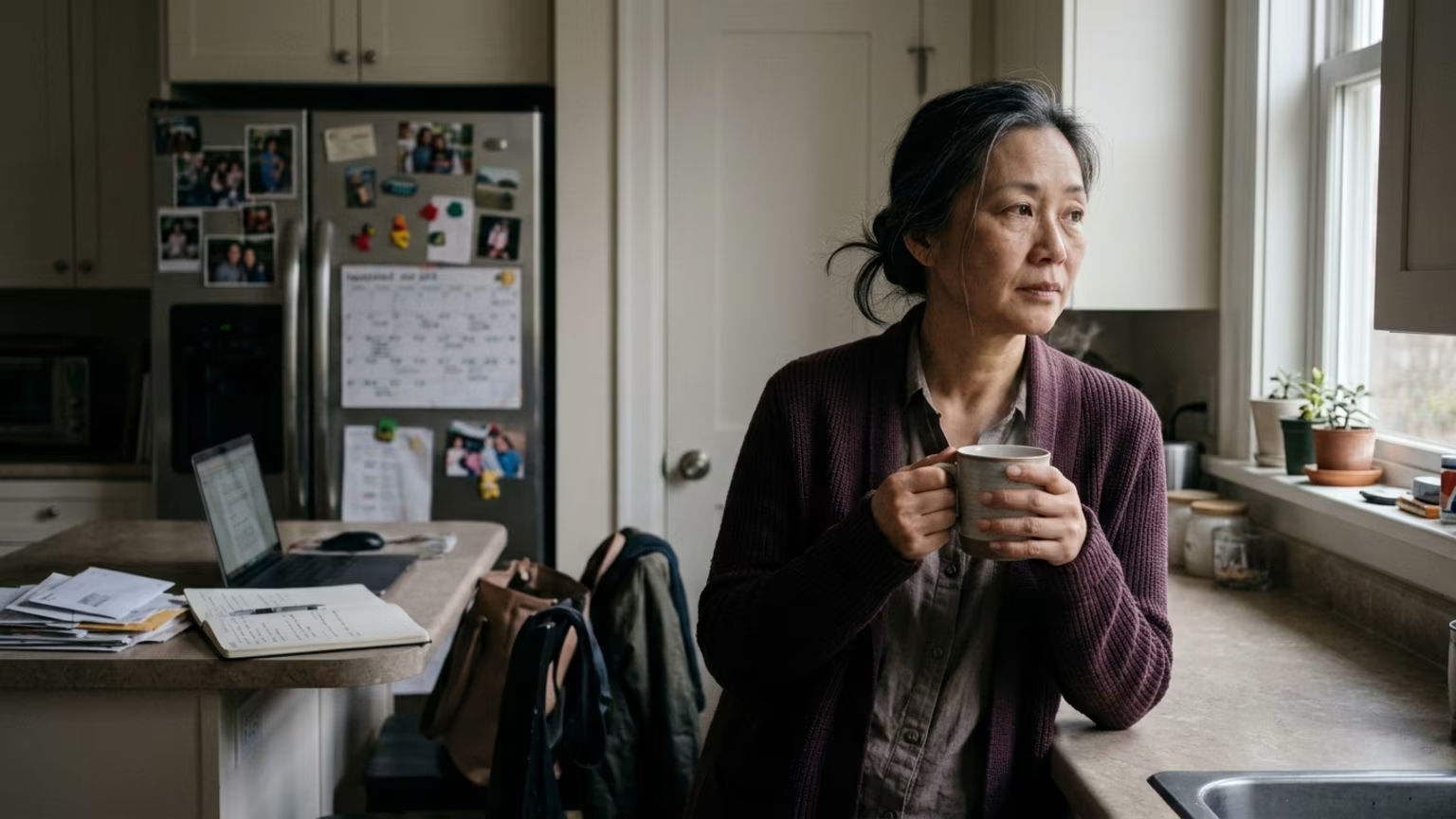

A wider view of midlife body confidence, with research on roles and sleep plus reflective prompts for a less appearance-dependent sense of self.





Body confidence in midlife can reflect physical changes alongside shifting roles, social expectations and available support, rather than hormones alone.
Not every concern about your changing body needs a hormonal explanation. That does not make a physical change unimportant. It means that the change itself and what it means to you are separate questions.
The 2026 review Midlife Transition and Psychosocial Experiences of Women in Menopause: A Systematic Review in India brought together 14 studies concerning Indian women. It identified body-image concerns alongside changing family roles and limited social support. Stigma and poor healthcare communication were also recurring themes.
The review’s findings support a wider conversation than how to correct a body that looks different. They bring relationships and social context into a subject that can otherwise become a private judgment about appearance.
You do not have to choose between caring about your body and questioning the expectations placed on it. A concern about fit or shape deserves to be heard. So does the feeling that you are expected to remain unchanged while the rest of your life moves on.
Changing family roles appeared among the Indian review’s recurring themes. That gives roles a place in the conversation about midlife experience rather than treating appearance as an isolated concern.
For personal reflection, it may help to name the expectations around a body concern. Are they expectations you value, ones you have inherited or ones you feel unable to question? You do not need to decide immediately which expectations to keep.
A role can be meaningful without being the whole of your identity. Asking where your own needs fit is not the same as rejecting people who depend on you. It is a way of making the question more specific than whether you like your reflection.
The point is not to replace a hormone-only explanation with a family-only explanation. It is to make room for the situation around you. You may find that one expectation feels negotiable while another needs a more careful conversation.
The 2026 study Factors Affecting Sleep Quality in Middle-Aged Women by Menopausal Stage: A Cross-Sectional Study examined 390 women in two South Korean cities. The perimenopausal group had the poorest sleep quality of the three menopausal-stage groups. Within that group, 78.9% were classified as having poor sleep quality.
Sleep therefore belongs in the wider conversation about how you are doing. It is reasonable to ask whether body concerns feel different after a difficult night or during a stressful period. That question is not an instruction to dismiss a concern as tiredness.
The evidence has clear limits: the Indian review describes experiences rather than their frequency in all women. The sleep study was cross-sectional, so it cannot establish that menopausal stage caused poor sleep or that its percentage applies elsewhere. Neither source establishes the relative contribution of hormones, sleep or social circumstances to an individual woman’s body confidence.
Refemina’s discussion of changes in mood, sleep and feeling like yourself offers another way into that broader conversation.
The practical ideas that follow are editorial applications of the research themes. They are reflection tools rather than interventions tested by these studies.
Start with a distinction between an observation and the conclusion attached to it. An observation might be that your clothes fit differently. A judgment might be that this makes you less attractive or less disciplined. The judgment is not another physical measurement.
A short written reflection could have three parts:
Then ask whether the meaning is the only possible reading of the observation. The purpose is not to argue yourself into liking every change. It is to stop a description of your body from becoming a verdict on your character.
If the judgment is especially loud in a particular setting, note the setting rather than assuming the feeling is the whole truth about your body. You might ask what happened just before it: a comparison, a comment or an expectation you were trying to meet. This is an invitation to notice context, not to blame yourself for having a reaction.
This approach also leaves room for mixed feelings. You can dislike a particular change while still treating yourself with care. You do not need a positive opinion about every feature before you are allowed comfort or respect.
For more on that distinction, read about building trust in your changing body.
Less appearance-dependent confidence does not mean appearance must stop mattering. Clothing and attractiveness may still be meaningful parts of your life. The aim is to give them company rather than asking them to carry your entire sense of self.
One reflective option is to make a list under three headings:
From there, a goal might be about returning to an activity you enjoy or making room for a relationship that matters. Another might concern comfort in your clothes rather than changing the body inside them. These are possible directions for reflection, not a new standard you must meet.
A question about strength belongs in a health conversation. A question about whether you still recognise yourself deserves its own space. Neither needs to cancel the other. When writing goals, notice whether they express something you want to do or something you feel obliged to prove.
Keep the goals proportionate to the life you have. A confidence exercise should not become another demand to be productive or impressive. Rest and ordinary enjoyment do not need an appearance-related justification.
It is also acceptable not to feel transformed by this stage of life. A less critical way of relating to yourself is a legitimate aim. You are not required to turn uncertainty into a reinvention story.
Thinking about the difference between confidence and self-trust may help you name which kind of support you want.
Practical support is one possible starting point when responsibilities leave little room for your own wellbeing. The question is not simply whether people around you are supportive. It is what a useful form of support would look like.
One way to make that concrete is to name a request:
These are options rather than a script you have to follow. The right request depends on what is missing and whom you trust. Support does not have to begin with agreement about how your body looks.
If body-image distress or related eating concerns are troubling you, an appropriately qualified health professional is a suitable person to speak with. You can describe what is bothering you and what you would like help understanding. The concern does not need to be reduced to either appearance or hormones before it deserves a conversation.
You also do not have to solve the entire picture in one appointment or one discussion. Naming the concern is a more realistic starting point than presenting a finished explanation. A useful conversation can leave room for both physical questions and the personal meaning of change.
Body confidence in midlife deserves a view broad enough to include physical changes, personal meaning and practical support, without making appearance the measure of your worth.
Body confidence can become another midlife demand when every change seems to require correction; Refemina places these concerns within a wider account of hormonal transition and personal identity. Its research-led coverage helps readers make sense of changing confidence without treating appearance as a problem to fix or reinvention as an obligation.

Follow Refemina for research-led insights on menopause, strength, metabolism, nutrition, skin, intimacy and confidence through midlife. New articles turn complex topics into clear, useful context.





Keep learning about the changes that shape energy, strength, confidence and wellbeing through midlife.
Explore Resources