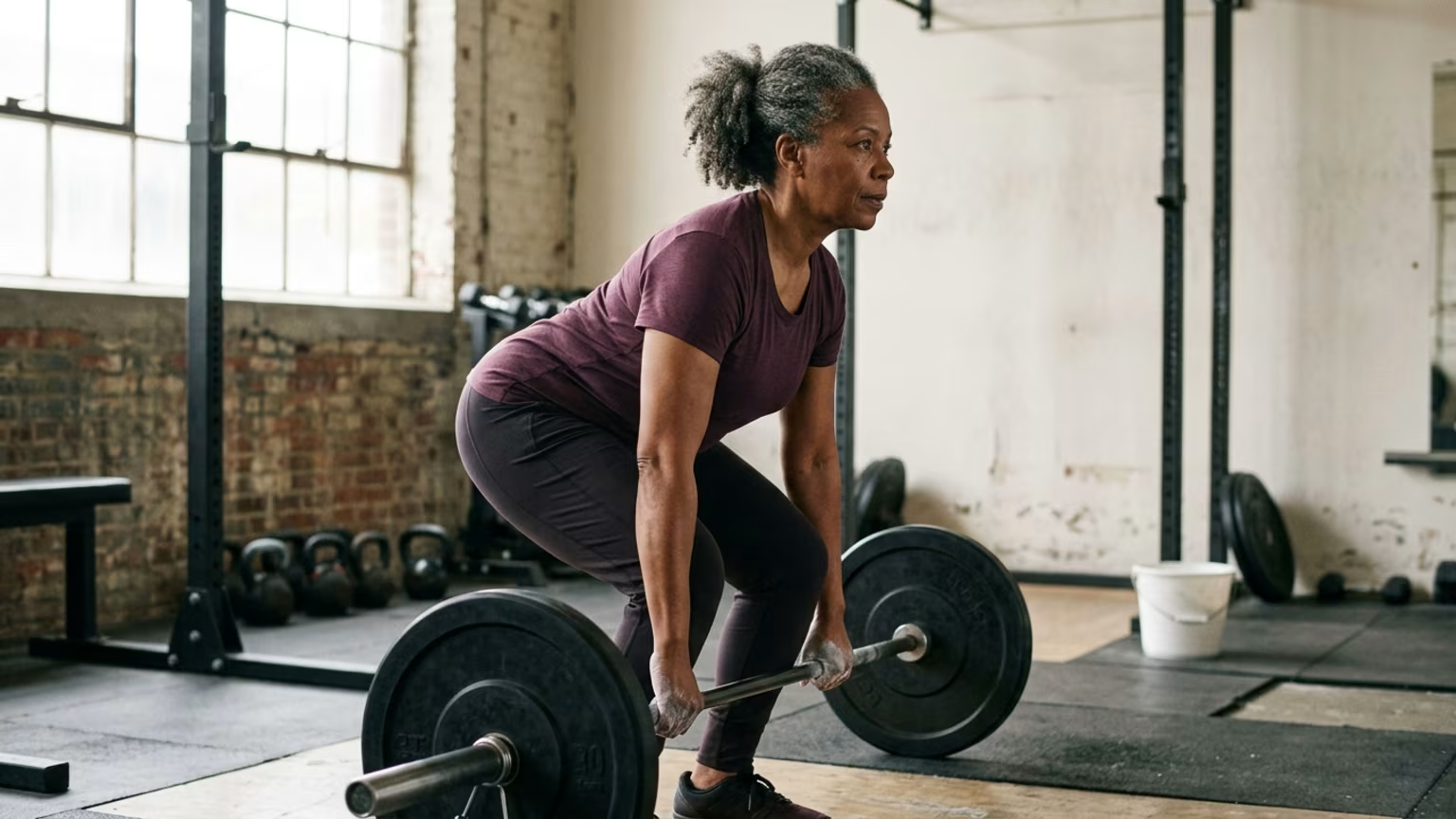

A menopause exercise report finds promise for strength, lean mass, power and spine bone density, with limits that matter for personal training decisions.





On October 26, 2026, IDEA Health & Fitness Association published an editorial report on a nine-month program of twice-weekly supervised heavy resistance and impact training during the menopause transition. Its coverage reported improvements in strength, lean mass, leg power and lumbar-spine bone mineral density.
The assumption under scrutiny is that exercise should automatically become lighter as women get older. IDEA’s interpretation challenges that approach by presenting heavier resistance and impact exercise as possibilities for appropriately screened participants.
This is not an announcement that an established medical standard has been replaced. It is a narrower update to the conversation about exercise programming: age alone should not settle the question of training intensity. Personal goals and circumstances still belong in that discussion.
IDEA’s summary brings together body composition, physical performance and a bone-density measure. These are separate outcomes rather than different ways of describing a single improvement.
The breadth of these outcomes is the most interesting part of the report. It places muscle, performance and bone within the same exercise discussion without requiring appearance or weight to become the organising theme.
For Refemina, that is a useful editorial direction. A woman’s reasons for training can include feeling physically capable and understanding changes in her body. Those priorities do not need to compete with an interest in appearance or confidence, but neither should they be reduced to it.
Readers interested in the wider exercise context can find related discussion of how resistance, impact and balance fit into bone-focused training. That broader context is distinct from the particular intervention IDEA reported.
A separate 2026 publication in BMC Medicine describes a cognitive-outcomes pilot sub-study drawn from the parent STOP-EM trial. It reports 35 participants: 17 in the resistance-training group and 18 in a wait-list control group.
That publication describes the parent study as a nine-month, twice-weekly supervised progressive resistance-training trial involving perimenopausal and early postmenopausal females. The pilot examined cognition and task-induced cerebral hemodynamics, meaning measures of brain blood-flow responses during tasks.
Those are not the muscle, lean-mass, leg-power or bone outcomes highlighted by IDEA. The pilot therefore belongs to a related research discussion rather than serving as the primary evidence for the physical changes in the exercise report.
This distinction matters when reading coverage across several publications. A participant count attached to a cognitive sub-study must stay attached to that analysis. It should not migrate into an account of muscle and bone findings simply because both publications concern resistance training during the menopause transition.
IDEA explicitly describes the initial research as limited and cautions against applying the precise program broadly. Its accessible article does not provide participant numbers, numerical effect sizes, detailed eligibility criteria or a full training prescription. The available reports also do not establish exact loads, progression details or adverse-event counts for the muscle-and-bone findings.
The accessible IDEA article does not name STOP-EM or directly link to the trial. The separate cognitive pilot cannot fill those gaps. Its authors describe their own findings as preliminary and call for larger studies.
Together, these limits mean the reported physical improvements cannot be quantified from the available summary or turned into a reproducible personal program. The coverage also does not establish weight loss or menopause-symptom relief. A feasibility finding is not proof of effectiveness for every woman.
That is the evidence boundary for this story. The useful next question is how to discuss the possibility of heavier training within an individual’s goals and circumstances, rather than attempting to reconstruct the intervention from a headline.
IDEA’s practical interpretation centres on appropriate screening and progressive exercise. For a reader interested in heavy resistance or impact training, the sensible application is a conversation with a qualified clinician or exercise professional about goals and constraints.
Medical history and bone health may affect what is appropriate. This does not turn the report into a blanket requirement for medical clearance. It means that a study summary should not make a personal decision that depends on information about the individual.
Useful discussion points follow directly from the report:
These are questions for shared discussion, not a trial-tested checklist. They do not supply a starting load or progression rule. The twice-weekly schedule is a description of the research rather than a frequency recommendation for every reader.
For women thinking about where training fits within everyday life, Refemina’s coverage of organising exercise across the menopausal transition offers a broader editorial context. The individual conversation remains about what fits the person, not how closely she can copy a study schedule.
There is a useful shift in perspective here. Instead of asking only whether exercise changes body size, this report invites attention to what researchers measured: strength, lean mass, leg power and lumbar-spine bone mineral density.
An editorial account can keep those outcomes visible without turning them into new standards women are expected to meet. Research findings describe what happened among participants. They are not a judgement on a reader’s current body or the value of her existing activity.
For women frustrated by changing body composition, the distinction is worth preserving. Interest in muscle and strength need not become another form of appearance pressure. Refemina’s discussion of keeping lean muscle in view rather than centring scale weight places that priority within its wider midlife coverage.
The most constructive reading of the IDEA report is therefore neither a demand to lift heavier nor a reason to dismiss heavier exercise. It is an invitation to ask a better question: which training possibilities fit a woman’s physical goals and personal circumstances?
This report may help shift exercise conversations toward individually assessed resistance and impact training rather than an automatic move to lighter exercise based on age alone.
Decisions about heavier resistance and impact training sit with the woman and her qualified exercise or healthcare professional; Refemina adds research-led editorial context. For women noticing shifts in strength or body composition, its coverage connects hormonal change with physical capability and confidence without turning midlife into a weight-loss project or a demand to look younger.

Follow Refemina for research-led insights on menopause, strength, metabolism, nutrition, skin, intimacy and confidence through midlife. New articles turn complex topics into clear, useful context.


Keep learning about the changes that shape energy, strength, confidence and wellbeing through midlife.
Explore Resources