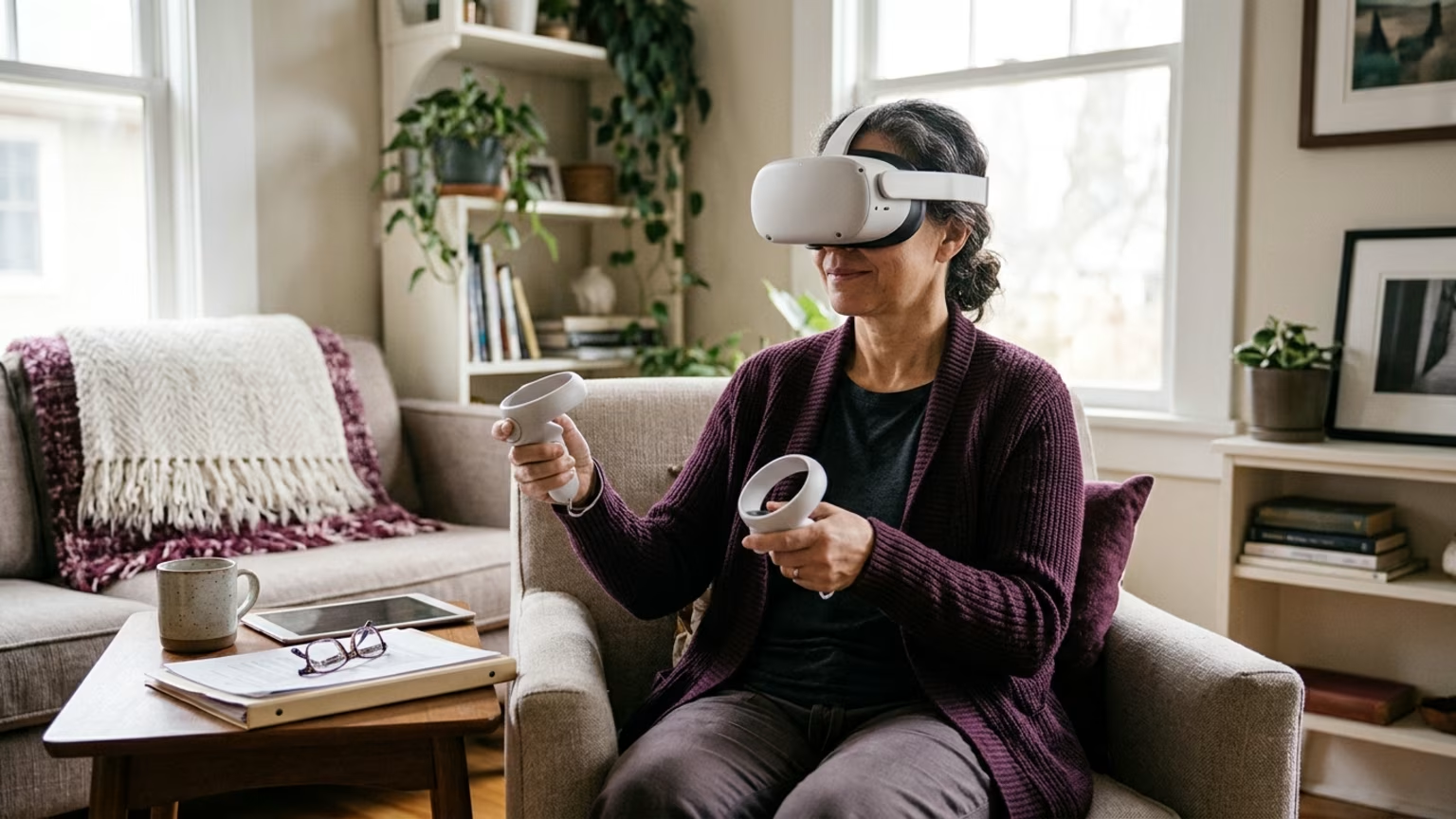

Early MenoZen VR findings suggest interest in non-drug menopause support. Clinical effectiveness remains unresolved, with larger studies needed.





In an announcement dated October 16, The Menopause Society reported findings from a small-scale, multicenter qualitative study of MenoZen VR, an AI-guided virtual-reality program developed for menopause symptom management. The notice carries an October 20 dateline and says the results were scheduled for presentation at the Society’s 2026 Annual Meeting in San Diego.
Non-drug menopause care did not begin with a headset. The Menopause Society describes cognitive behavioral therapy (CBT) as an evidence-based approach for several menopause-related concerns. Its announcement identifies limited access to conveniently located providers as a barrier to receiving that support.
Separately, ACOG’s October 2026 announcement included CBT and mindfulness-based interventions among its nonpharmacologic recommendations for vasomotor, sleep and mood symptoms. It also listed exercise, clinical hypnosis and acupuncture. Those recommendations concern approaches to care rather than a particular digital product.
The foundation for the MenoZen research is therefore the evidence behind approaches such as CBT. The proposed update is the way support reaches women. This distinction keeps the clinical question in view: whether a different delivery format can bring useful care within reach without confusing the technology with the treatment itself.
According to The Menopause Society, the study examined a menopause-specific program combining behavioral and educational elements in a virtual environment. The announcement describes the following findings and features:
The available notice does not provide a participant count, a quantitative acceptability score, a comparison group or a measured clinical outcome. Interest and early feasibility therefore remain separate from evidence of symptom improvement. Dr. Stephanie Faubion, medical director of The Menopause Society and a study author, said larger studies are needed to determine clinical effectiveness.
The announcement also does not state how long participants used the program or how many completed it. It does not describe an assessment of adverse effects or an evaluation of the AI’s accuracy, privacy or safety. These are unanswered questions in the public information, not evidence that problems occurred.
Because the program combines several approaches, the announcement cannot establish which elements participants found appealing or whether the VR format itself made a difference. The word “personalized” describes the kind of support that interested participants; it is not a reported measurement of how accurately the AI adapted to individual needs.
The recruitment criteria also limit the reach of the finding. These experiences should not be extended to all women in perimenopause or postmenopause. The announcement reports no outcomes for body composition, sexual wellbeing or energy, so it does not support a claim that one program addresses the wider range of midlife concerns.
Taken together, these boundaries place MenoZen VR at an early research stage. The material available here is an advance announcement about a qualitative study rather than a full clinical report establishing a treatment benefit.
The Society’s rationale deserves attention beyond the technology. Its announcement identifies provider availability, cost and convenience as challenges in accessing nonpharmacological support. Those are practical questions about receiving care rather than a reason to assume women need a more elaborate device.
A VR program is a proposed route around some of those obstacles, not an automatic solution to them. A meaningful assessment of access would need to examine the whole experience. Obtaining and using the equipment is one question; finding appropriate support and fitting the program into ordinary life are others.
The broader ACOG announcement also helps keep the options in perspective. It places nonpharmacologic interventions within menopause care without making virtual reality a requirement. Its recommendations should not be read as an endorsement of MenoZen VR.
For women interested in support without medication, the useful starting point is the concern being addressed and the evidence for the approach. The delivery format comes after that. A clinician can help discuss which evidence-based options fit the symptoms and circumstances involved.
The practical response to an early digital-health announcement is neither automatic enthusiasm nor automatic dismissal. It is a focused set of questions about the proposed service. These are consumer questions, not confirmed features or safeguards of MenoZen VR:
A conversation about describing menopause concerns to a clinician can begin with the symptom and its effect on daily life, rather than with a request for a particular device. That keeps personal care decisions with a qualified professional while leaving room to discuss emerging options.
The wider editorial lesson is to keep different kinds of evidence in their proper places. Established evidence for an underlying approach, interest in a new delivery format and demonstrated benefit from a specific product are separate questions. Each deserves a clear answer rather than being compressed into a single technology headline.
For clinical practice, this research points toward testing new routes to behavioral support while keeping patient outcomes, rather than technical novelty, as the standard for adoption.
A menopause program can attract interest before its place in care is clear; Refemina works within that gap by keeping evidence and possibility distinct. For women facing contradictory messages about perimenopause and postmenopause, its coverage connects hormonal transition with the wider midlife experience to support clearer understanding without alarm or pressure to choose one answer.

Follow Refemina for research-led insights on menopause, strength, metabolism, nutrition, skin, intimacy and confidence through midlife. New articles turn complex topics into clear, useful context.


Keep learning about the changes that shape energy, strength, confidence and wellbeing through midlife.
Explore Resources