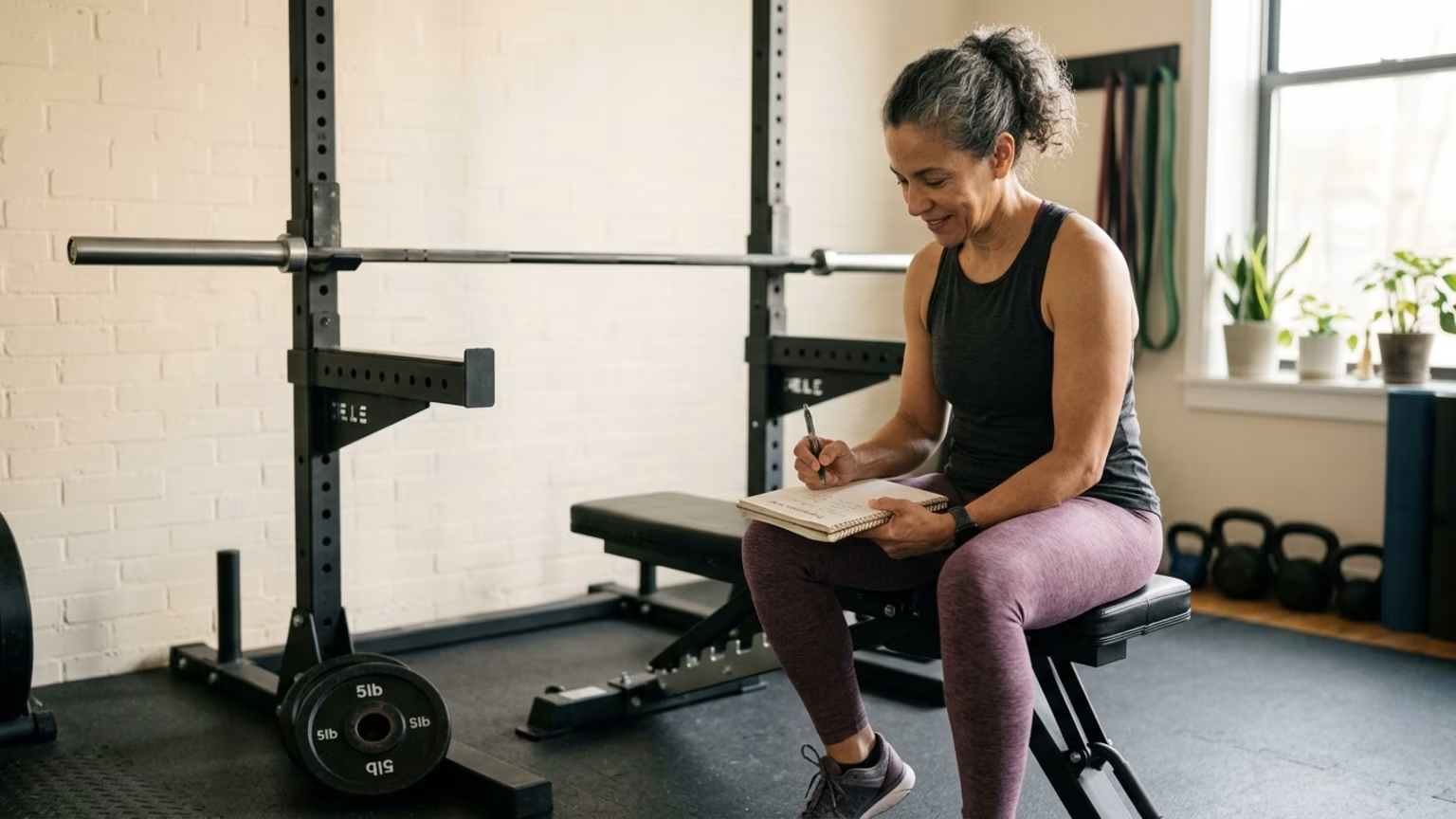

Recent evidence challenges the idea that midlife women must lift very heavy weights to build strength, highlighting consistent, moderate progression instead.





On October 1, 2026, Women’s Health UK published an article featuring former orthopaedic surgeon Dr Kate Ella that challenges the assumption that midlife women must lift very heavy weights to build strength.
For years, prevailing fitness messaging suggested that postmenopausal women needed to prioritize lifting maximum loads to maintain muscle and bone health. This approach frequently presented gym-based, high-intensity resistance work as the only valid method to counteract physical changes. Women were repeatedly told that lifting heavy weights three times a week was a required baseline for seeing physical improvements. This rigid focus on heavy lifting created barriers for individuals who lacked access to gym equipment or felt intimidated by heavy barbells.
A closer look at recent physical health research reveals a more nuanced picture regarding strength requirements. Recent evaluations of exercise protocols highlight several key findings that redefine physical capability:
The article published by Women’s Health UK emphasizes accessibility and consistency over specific heavy loads. Dr Ella suggests that individuals can start strength training with bodyweight exercises or simple household objects. This approach removes the immediate need for a specialized gym membership or heavy metal plates. The central point is not that heavy lifting is ineffective, but rather that it is not the only valid way to begin strength work.
Progression remains a core principle of any successful physical routine for midlife women. A program must challenge the muscles progressively over time to create meaningful adaptations. Individuals can increase this physical challenge by adding repetitions to their sets or increasing their total weekly training volume. Adjusting the time under tension by consciously slowing down the movement offers another powerful way to stimulate muscle growth.
Dr Ella's recommendations align well with the physiological realities of building muscle endurance during the midlife transition. When a person slows down a repetition, the muscle fibers work for a longer continuous period. This increased time under tension forces the body to recruit more muscle fibers to complete the movement safely. Such targeted mechanical tension drives muscular adaptation just as effectively as adding a heavier plate to a barbell.
Using household objects creates an immediate bridge between daily functional tasks and structured exercise routines. A heavy water jug or a loaded backpack provides enough initial resistance to stimulate muscle growth for a beginner. This practical approach demystifies strength work and positions it as a normal part of daily life. Over time, this functional strength translates into an easier daily routine and increased physical independence.
Dr Ella cautions against treating resistance work as the sole focus of midlife physical activity. A comprehensive routine should include cardiovascular work, mobility exercises, and dedicated balance training. Mobility exercises support long-term joint health, while balance training helps maintain stability and physical confidence. Navigating changes in strength, body composition and metabolism requires a holistic view of bodily capability.
The Women’s Health UK article highlights broader longevity benefits associated with this varied physical approach. The publication reports that a study published in The BMJ found a 29 percent lower risk of death for individuals completing recommended cardiovascular exercise. The reported figures show an 11 percent lower risk for those doing strength training alone. Combining both exercise types was associated with a 40 percent lower risk of death among the nearly half a million people studied.
Many women equate strength training exclusively with preventing bone loss, but clinical data presents a much more complex picture. The 2026 review in Frontiers in Endocrinology examined exercise therapy for osteoporosis and detailed highly specific outcomes. A meta-analysis of 80 randomized trials in postmenopausal women showed a standardized mean difference of 0.29 for lumbar spine bone mineral density. Femoral neck bone density saw a standardized mean difference of 0.27 in the exact same analysis.
The focus on absolute bone mineral density numbers often overshadows the broader functional benefits of resistance work. While the standardized mean difference of 0.29 for lumbar spine density seems small, it represents a positive shift in overall bone health. The modest absolute changes of less than one to two percent are typical for exercise interventions in this demographic. Proper nutrition and weight management also play a role in supporting bone architecture during these specific hormonal shifts.
The Frontiers review also detailed a comprehensive network meta-analysis involving 49 separate trials to evaluate different exercise combinations. Combined resistance and impact training ranked highest for improving lumbar spine and femoral neck bone mineral density. Resistance training alone took the second position, while impact exercise alone ranked third in effectiveness. Women moving through perimenopause and menopause often seek clear physical guidance, yet individual physiological responses to exercise vary widely.
The most pressing question for many women is whether high intensity is strictly required for maintaining bone health. The review found sparse and uncertain evidence regarding high-intensity physical interventions across the broader population. One meta-regression within the review found no significant association between resistance intensity expressed as a percentage of one-repetition maximum and bone density changes. The review did note a larger lumbar spine estimate for high-intensity exercise in another analysis, but this was based on only four trials.
The sparse evidence surrounding high-intensity interventions highlights a significant gap in current exercise science for midlife women. Many popular fitness programs recommend pushing to muscular failure, but the meta-regression shows no clear bone density benefit from maximum intensity. This lack of a clear dose-response relationship provides freedom for women to choose lighter weights if they prefer. It removes the pressure to constantly pursue heavier lifts in the name of skeletal health.
These specific findings challenge the widespread notion that heavier weights are universally necessary for positive bone outcomes. The reviewed clinical evidence suggests that the useful discussion is not simply heavy versus light. Program type, steady progression, professional supervision, and participant health all matter deeply for bone outcomes. The relative contributions of these specific factors remain poorly quantified in the current scientific literature.
Clinical trials that show clear benefits from high-intensity training often involve highly controlled and monitored environments. The LIFTMOR trial involved otherwise healthy postmenopausal women with low bone mass doing supervised, twice-weekly high-intensity resistance and impact training. After eight months, their lumbar spine bone density rose about 2.9 percentage points. Femoral neck density was maintained at a positive 0.3 percent change for the same supervised group.
The review heavily cautions that these specific findings come from selected participants under strict clinical supervision. Translating those results directly to frail individuals or those with complex health histories requires careful medical consideration rather than blanket recommendations. Evidence from high-intensity physical programs is drawn largely from relatively healthy participant groups. The generalizability to people with substantial comorbidity or multiple past fractures remains largely unclear.
Understanding the specific limitations of exercise research helps women make informed choices about their physical routines. The review explicitly notes that exercise-related bone density improvement has not been validated as a surrogate for anti-fracture efficacy. Trials have not established that exercise alone reduces fragility fracture incidence in older adults with established osteoporosis who are eligible for medication. Bone mineral density acts as a surrogate measure rather than a direct count of prevented physical fractures.
Women navigating these complex health choices should focus on building comprehensive physical capability. Viewing daily exercise solely as a medical fracture prevention tool places unnecessary pressure on the physical activity. Finding reliable context for these physical shifts requires separating objective clinical facts from fitness industry marketing. Developing mental fitness and physical confidence becomes much easier when the focus shifts to practical, sustainable movement.
The main takeaway from both Dr Ella’s insights and the clinical review is a necessary shift toward realistic movement strategies. For individuals who find heavy gym lifting highly impractical, beginning with simple bodyweight movements offers a highly accessible entry point. The focus remains squarely on finding an activity that is manageable, repeatable, and appropriately challenging for the individual. This balanced approach removes the initial intimidation factor from starting a new physical routine.
Integrating these updated findings into daily life requires a shift away from all-or-nothing fitness mindsets. Women often feel that if they cannot lift heavy weights three times a week, they should not bother lifting at all. Dr Ella’s insights directly counter this unhelpful narrative by validating moderate, consistent resistance work. Doing fifteen careful repetitions with a moderate weight builds genuine strength and improves neuromuscular coordination.
Prioritizing steady consistency allows women to build a healthy relationship with movement that lasts for many years. When digital health content insists on high-load lifting, it can create an artificial physical barrier to entry. Women can cultivate significant bodily strength and functional capacity using moderate resistance and varied programming. Going forward, clinical practice will likely prioritize manageable, repeatable exercise protocols over universal heavy-lifting mandates for midlife strength development.
Developing manageable, repeatable exercise protocols for midlife strength requires objective facts rather than rigid fitness rules, which is exactly how Refemina approaches women's health. Confusion about which midlife changes are hormonal and which have multiple causes often complicates physical routines, but we translate credible evidence into clear adult guidance to help you maintain capability and confidence.

Follow Refemina for research-led insights on menopause, strength, metabolism, nutrition, skin, intimacy and confidence through midlife. New articles turn complex topics into clear, useful context.



Keep learning about the changes that shape energy, strength, confidence and wellbeing through midlife.
Explore Resources