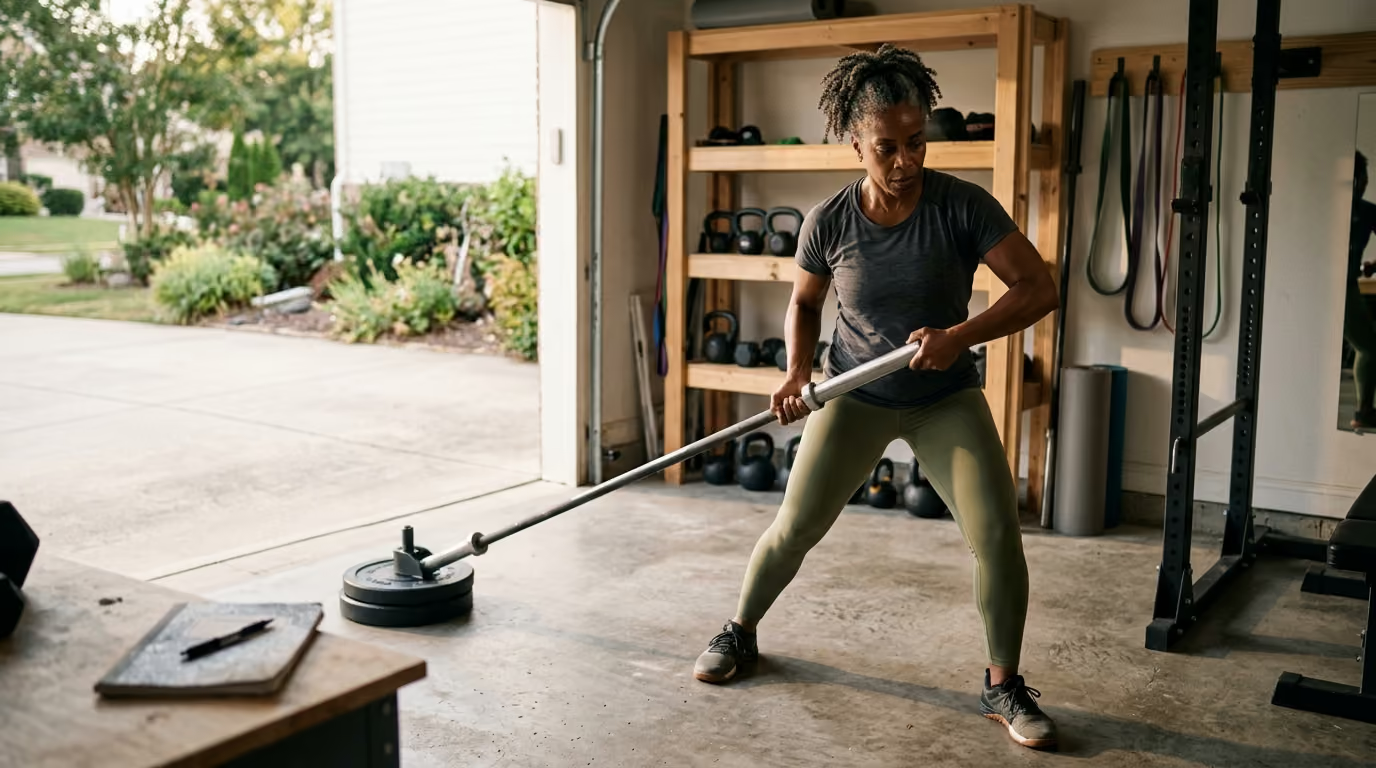

Lifting heavy weights can feel intimidating when joints ache, so this progression framework adapts foundational movement patterns to restore midlife strength and balance safely.





Chasing perfect exercise form is often the single biggest obstacle to building real physical capacity in midlife. Many women are told that a squat must reach a specific depth, a deadlift must start from the floor, or an overhead press requires pristine spine position.
When a movement feels awkward or causes joint discomfort, the typical reaction is to assume the body is broken or the movement is off-limits. This rigid mindset treats exercise as a strict test you either pass or fail.
In reality, strength training works best as a continuous practice of fundamental movement patterns. A pattern is not a single exercise with an unyielding set of rules. It is a broad category of movement that can be adapted using different weights, ranges of motion, stances, and levels of support.
By shifting your focus from chasing ideal form to finding workable options, training becomes far more productive. You can build capacity, protect your joints, and maintain muscle through perimenopause, menopause, and beyond without demanding that your body fit a generic template.
The World Health Organization explicitly recommends that all adults complete muscle-strengthening activities involving every major muscle group on two or more days per week. For adults over 65, official guidelines add multi-component movement emphasizing functional balance and strength at least three days per week to help prevent falls and maintain independence.
Research consistently demonstrates that progressive resistance training helps counter age-related declines in muscle force, bone density, and functional capacity. A comprehensive review examining resistance training in older populations found that structured strength work produced average gains of 6.6% to 37% in maximum strength. The same analysis noted functional capacity improvements up to 58%, alongside measurable gains in muscle mass and power.
These findings align with position statements from the National Strength and Conditioning Association. The association reports that properly designed resistance training reduces fall risk and builds resilience against physical stress in aging adults.
At the same time, high-quality evidence cautions against over-simplifying what strength training achieves. A recent meta-analysis of resistance exercise in older adults found clear improvements in lower-body strength, grip strength, flexibility, static balance, dynamic balance, and confidence. However, that same meta-analysis showed no statistically significant change in total skeletal muscle mass or body fat percentage.
This research highlights an vital distinction for midlife women. You can gain dramatic improvements in physical power, stability, joint health, and day-to-day capability without seeing dramatic alterations in your body weight or composition. Strength is a neuromuscular and functional adaptation, not simply a cosmetic outcome.
Navigating midlife involves distinct shifts in biology, lifestyle, and recovery capacity. Hormonal fluctuations during perimenopause and menopause affect muscle protein synthesis, tendon elasticity, joint lubrication, and sleep quality.
Estrogen plays a key role in maintaining collagen health and supporting muscle repair. As estrogen levels fluctuate and eventually decline, tendons and ligaments may feel stiffer or take longer to adapt to heavy loading. You might notice that a workout schedule you easily tolerated in your thirties now leaves you feeling fatigued or joint-sore.
Sleep disruptions caused by night sweats or altered circadian rhythms can further reduce your capacity to recover from intense training. When sleep quality drops, systemic inflammation can rise, making connective tissues more sensitive to strain.
These physiological changes do not mean your body is failing, nor do they mean you should stop lifting weights. They simply mean that your tolerance for rapid changes in load, range, or volume may be narrower than it once was.
Adapting your training strategy requires recognizing these realities without treating normal biological transitions as chronic physical impairments. You can explore targeted advice in our section covering hormonal changes in midlife to see how physiology interacts with daily routines.
Good exercise technique is often defined by strict visual criteria, such as a perfectly upright spine or deep knee flexion. In a clinical and practical context, proper technique is far more dynamic.
Effective technique is movement that is repeatable, controlled, appropriate for your current capacity, compatible with your training goals, and comfortable for your joints.
Every person brings a unique set of constraints to a workout session. Structural anatomy, femur length, hip socket shape, ankle mobility, past joint injuries, and current fatigue levels dictate how an exercise looks. A tall woman with long femurs will naturally lean forward more during a squat than a shorter woman with compact limbs. Neither variation is wrong; both are normal expressions of individual leverage.
Coaching cues should separate non-negotiable safety standards from modifiable preferences:
Range of motion is another area where flexibility matters. Systematic reviews on resistance training show that training through fuller usable ranges of motion generally leads to greater strength gains and lower-limb muscle growth than training through partial ranges.
However, meta-analyses also confirm that partial-range training offers viable strength adaptations, particularly when full depth causes joint irritation or when a specific position requires confidence building. Range of motion is a variable to develop over time, not a strict requirement for entry.
To build comprehensive physical capacity, structure your workouts around six primary movement patterns. Each pattern represents a broad mechanical task rather than a single fixed exercise. You can review our wider library of strength training resources for additional program design tools.
Lowering and raising the center of mass through coordinated flexion and extension of the hips, knees, and ankles while keeping the trunk stable.
If deep knee flexion triggers front knee discomfort, raise the target height and work within a pain-free range. If limited ankle mobility causes heels to lift or forces an extreme forward lean, place small wedge blocks or small weight plates under the heels to support comfortable upright posture.
Bending forward primarily at the hip joint while maintaining a stable, organized spine and engaging the posterior chain muscles.
For individuals cautious about bending due to historical lower back stiffness, elevate the starting position so the weight rests at mid-shin or knee height. This reduces the range of motion while allowing the hips to absorb the load safely.
Producing and absorbing force in a staggered stance or single-leg position while challenging balance, lateral hip stability, and single-leg strength.
Forward lunges introduce braking force that can aggravate sensitive knees. Switching to a reverse lunge keeps the shin of the working leg more vertical, significantly reducing joint stress at the knee while training the glutes and quadriceps effectively.
Pressing an external load away from the chest or shoulders, or pushing the body away from a fixed surface while managing shoulder blade movement.
Overhead pressing can cause shoulder pinching if thoracic mobility or shoulder joint space is limited. Moving to an incline dumbbell press or neutral-grip floor press offers a highly productive pressing stimulus while avoiding uncomfortable shoulder angles.
Drawing an external resistance toward the torso or pulling the body toward a fixed anchor while coordinating shoulder blade retraction and elbow flexion.
If grip strength becomes the limiting factor during heavy rows, use supportive lifting straps. This allows back muscles to receive an adequate challenge without the session ending early due to forearm fatigue.
Transporting a load over distance or holding a weight stationary while maintaining upright alignment, bracing the trunk, and walking with steady control.
Carries offer high functional value for everyday activities such as carrying luggage or grocery bags. If shoulder joint pain prevents carrying weights at your sides, use a front hug hold close to your chest to keep the center of mass stable.
Systematic progression prevents training plateaus and reduces injury risk. Building capacity does not mean adding weight to the bar every single week.
Follow a four-stage progression ladder to guide how you alter movement variations over time:
Never alter multiple training variables simultaneously. If you decide to increase the weight on a squat, do not lower the box target, remove hand balance support, and add three extra repetitions in the same workout.
Changing too many factors at once makes it impossible to identify what caused success or triggered joint irritation.
The American College of Sports Medicine recommends that novice trainees perform exercises using loads corresponding to an 8 to 12 repetition maximum. For intermediate lifters, broader spectrums from 1 to 12 repetitions can be introduced systematically.
A practical method for managing effort without pushing to joint pain is tracking Repetitions in Reserve (RIR):
Recent research comparing training to complete failure versus stopping 1 to 2 repetitions short of failure found nearly identical muscle growth across eight weeks. A 2024 meta-analysis confirmed that maximal strength increases are well-supported when leaving repetitions in reserve.
Stopping most sets 1 to 3 repetitions shy of failure builds strength effectively while minimizing systemic fatigue and protecting connective tissue. You can browse our collection of midlife strength and body composition guides for detailed breakdowns of training intensity.
To apply load safely, use a simple double progression model:
To demonstrate how pattern progression applies across real life contexts, consider these five illustrative models. These examples show how movement variations can be tailored to individual needs without making claims about specific clinical outcomes.
Most exercise adjustments can be managed by altering load, leverage, range, or exercise selection. However, distinguishing between benign exercise discomfort and symptoms that warrant professional medical evaluation is essential.
Modify or pause an exercise if you experience:
When these symptoms arise, consult a qualified healthcare provider, such as a physical therapist or physician. Clinical evaluation ensures underlying joint or nerve issues are accurately diagnosed before resuming progressive loading. To read more about how we evaluate health evidence, visit our page on the Refemina editorial approach.
Misinformation often creates unnecessary fear around strength training. Clearing up common myths allows you to make informed decisions grounded in research.
This long-standing belief claims that letting the knees move forward over the toes increases knee injury risk. Biomechanical research shows that allowing forward knee travel is a normal part of functional squatting and stair climbing. Restricting forward knee movement shifts mechanical stress heavily onto the lower back and hips. Unless you have a specific joint restriction, let your knees move naturally over your toes.
While bodyweight exercises are valuable, holding a light dumbbell or kettlebell in a goblet position can actually make squatting easier. The external weight acts as a counterbalance, allowing you to stay upright and sit into the movement with better control than an unweighted squat permits.
Pushing every exercise set to failure causes disproportionate neural and connective tissue fatigue without offering extra strength benefits. Research confirms that leaving 1 to 3 repetitions in reserve yields strong muscle adaptations while preserving recovery capacity.
High repetition sets with light weights build local muscular endurance, but they do not provide the mechanical tension required to build bone mineral density and high-level muscle strength. Once movement patterns are well-controlled, introducing moderate and heavier loading is safe, effective, and strongly supported by clinical guidelines.
Lifting weights develops muscle strength, improves balance, and supports metabolic health. However, clinical meta-analyses demonstrate that strength training alone, without concurrent nutritional adjustments, does not reliably produce fat loss or large changes in scale weight. Strength training should be valued for functional power, joint integrity, and long-term vitality.
While current exercise science offers clear direction, acknowledging gaps in research prevents overstating what is known.
Much of the classic strength training literature historically focused on younger male populations. While studies involving midlife and older adults have expanded significantly over the last two decades, specific trials examining perimenopause-specific exercise protocols remain limited.
Many published studies on aging adults utilize relatively short intervention periods, typically lasting 8 to 12 weeks. Long-term observational data spanning decades is harder to capture. Consequently, optimal protocols for precise loading changes during specific menopausal stages are still evolving.
Individual responses to exercise programs also vary widely. Genetics, lifelong physical activity habits, dietary protein intake, stress levels, and concurrent medical conditions influence how rapidly someone gains strength or recovers from training.
No single exercise template works identically for everyone. Treat published guidelines as valuable starting baselines rather than rigid laws. You can read broader context across our main midlife health articles index.
Focus on finding workable movement variations that build confidence, protect your joints, and keep you moving consistently.

Follow Refemina for research-led resources on hormonal change, strength, metabolism, nutrition, skin, intimate wellbeing and confidence through midlife.


Keep learning about the changes that shape energy, strength, confidence and wellbeing through midlife.
Explore Resources