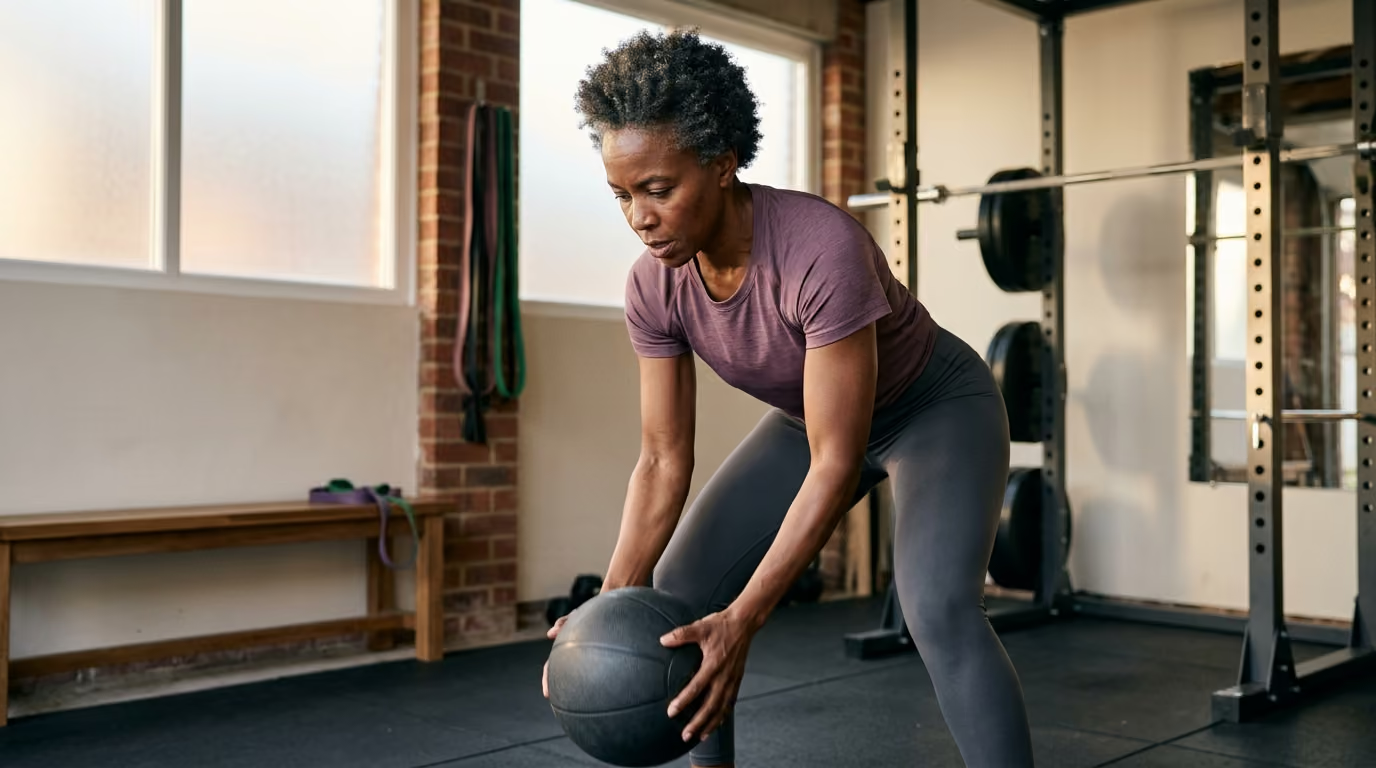

Greater everyday speed and movement confidence come from targeted power exercises designed to protect midlife joints and restore fast-twitch muscle strength safely.





You miss a step on the stairs, or your foot catches the edge of a sidewalk curb. In that fraction of a second, your muscles must fire immediately to extend your leg, plant your foot, and catch your body weight before you hit the ground. That quick reaction does not depend purely on how much weight you can lift in the gym. It depends on muscle power: how rapidly your nervous system and muscle fibers can generate force.
Muscle power is the product of force multiplied by speed. Traditional strength training focuses on how much force you can produce against resistance. Power training focuses on how quickly you can express that force. For women navigating midlife, this distinction is fundamental. Research indicates that muscle power begins to decline earlier and faster than maximal strength, directly affecting stair climbing, balance recovery, and general physical capability.
The scientific literature shows that power training improves functional performance and movement quality across midlife and older adulthood. Systematic reviews demonstrate that training with high movement velocity produces greater gains in functional tasks, such as rising from a chair or climbing stairs, compared to slow resistance training alone. Crucially, developing power does not require box jumps or risky plyometrics. It begins with the simple intention to move a light or moderate load with controlled speed.
Understanding how to train for speed helps you maintain physical independence and agility. By building a balanced routine that combines baseline strength, fast force production, and reactive balance, women over 40 can protect their joints, maintain bone health, and move with steady confidence.
To build an effective training program, you must separate strength, power, and speed into clear categories. While these physical qualities work together, they represent distinct neuromuscular adaptations.
Maximal strength is the greatest amount of force a muscle group can voluntarily produce, regardless of how long it takes. When you perform a slow, heavy deadlift or carry a heavy suitcase, you are relying primarily on maximal strength. Rate of force development describes how quickly force rises from a resting state once a movement begins. Muscle power combines force and velocity, representing the total rate of performing work. Movement speed refers to how rapidly a limb or the whole body travels across space.
A woman can possess substantial maximal strength but still lack sufficient power. For example, you might have the leg strength to complete a deep squat under load. If you cannot recruit those muscle fibers in a fraction of a second, you may still struggle to rise briskly from a low sofa or catch yourself during a slip.
Age-related changes in muscle tissue affect fast-twitch fibers more dramatically than slow-twitch fibers. Starting around age 40, lower-limb power begins a gradual decline that often accelerates after age 50. Studies show that knee extensor peak torque and leg power drop earlier in women than in men. Because power is movement-specific, maintaining it requires deliberate practice across multiple directions rather than relying solely on slow, steady resistance exercises.
Developing muscle power requires training the nervous system to recruit motor units rapidly. When you lift a weight with high intent, your brain sends faster electrical signals to your muscle fibers. This neuromuscular coordination improves how quickly you can react to physical demands in daily life. For a deeper understanding of muscular adaptations, review our resources on midlife strength and body composition.
The physical shifts that occur during perimenopause and postmenopause extend beyond reproductive hormones. Changing estrogen levels interact with neuromuscular function, muscle protein synthesis, and connective tissue stiffness.
During the menopause transition, estrogen fluctuations influence how muscles recover and repair. Estrogen plays a protective role in muscle quality and tendon elasticity. As circulating estrogen levels decrease, women often experience subtle reductions in lean muscle mass, alongside changes in tendon stiffness. These changes can alter the rate at which force is transmitted from the muscle belly through the tendon to the bone.
These physiological adaptations do not mean your body is failing. They simply represent a shift in baseline mechanics that requires an updated training approach. Slow, monotonous cardio alone does not stimulate the high-threshold motor units responsible for rapid force production. Without deliberate speed stimulus, fast-twitch muscle fibers atrophy faster than slow-twitch endurance fibers.
Lower-body muscles experience greater age-related power loss than upper-body muscles. The quadriceps, glutes, and calf muscles are vital for gait speed, balance, and vertical propulsion. When midlife hormonal shifts intersect with sedentary habits, lower-body power can diminish without obvious warning. Addressing these changes early preserves functional movement for decades to come, especially when paired with insights on hormonal changes in perimenopause.
The loss of rapid force production rarely announces itself dramatically. Instead, it creeps into daily routines through subtle physical compensations that feel like normal aging.
You might notice yourself using your hands to push off the armrests when standing up from a deep chair. You might find yourself hesitating at the top of a flight of stairs, or feeling slightly uncoordinated when stepping off a moving escalator. Some women notice that their walking pace slows when crossing a busy street, even though their endurance for steady walking remains fine. These subtle shifts often stem from diminished power rather than a lack of cardiovascular stamina.
Compensations mask underlying power deficits. When you pull yourself up using a railing or lean forward excessively to stand, you reduce the explosive demand on your hip and knee extensors. Over time, these movement workarounds accelerate the loss of the very power you are avoiding.
Power also directly influences balance and fall prevention. A trip or slip occurs in milliseconds. Preventing a fall requires an immediate, powerful step to widen your base of support. If your leg muscles cannot produce rapid force, a minor stumble can turn into a serious fall. Preserving this physical capability maintains personal autonomy, athletic confidence, and everyday freedom of movement.
Introducing speed into your workouts requires a methodical, step-by-step framework. Speed should never be added to dysfunctional movement patterns. By following established exercise principles, you can develop rapid force safely.
First, establish baseline movement competence. Before attempting to move quickly, you must demonstrate controlled mechanics through a full, pain-free range of motion. If a standard squat causes knee discomfort or spinal rounding at a slow pace, adding velocity will only amplify those errors. Build structural control first, introduce speed second, and add external resistance third.
Second, understand the power continuum. Power training exists on a spectrum from low-impact intention to high-velocity ballistic movements. Beginners can reap substantial neuromuscular benefits simply by performing familiar exercises with the intent to lift quickly, even if the actual movement speed appears moderate.
Third, manage fatigue strictly. Power training targets the nervous system. When you become fatigued, your movement velocity drops, and your technique deteriorates. Unlike metabolic conditioning, where the goal is cardiovascular fatigue, power sets should remain short, crisp, and fully recovered.
Stop every power set before your movement slows down. If your plan calls for five repetitions, but your fourth repetition looks noticeably slower or heavier than your first, end the set immediately. Rest between 60 and 90 seconds between power sets to allow your nervous system and cellular energy stores to recharge.
You do not need to leave the floor to train power effectively. Low-impact power training delivers excellent neuromuscular stimulation while keeping joint stress minimal. These exercises focus on rapid concentric action paired with controlled, smooth eccentric lowering.
The sit-to-stand pattern is the foundation of lower-body power. It directly strengthens the hip and knee extensors needed for rising from furniture and climbing stairs.
Begin seated on a sturdy chair with your feet flat on the floor, hip-width apart. Cross your arms over your chest. Lean slightly forward from your hips while keeping your spine straight. Drive your feet into the floor and stand up as rapidly as you can without jumping. Pause at the top in a tall, stable posture. Lower yourself back down slowly over a count of three seconds until you lightly touch the chair. Complete 3 sets of 4 to 6 repetitions.
The calf complex and Achilles tendon provide propulsion during walking and rapid stabilization during balance perturbations.
Stand tall facing a wall or sturdy rail with your fingertips lightly resting on the surface for balance. Keep your knees straight but not locked. Drive through the balls of your feet to raise your heels as quickly as possible. Hold the top position for a split second, then lower your heels back to the floor slowly. Focus on vertical drive rather than letting your ankles roll outward. Perform 3 sets of 6 to 8 repetitions.
Upper-body power is essential for bracing against falls, pushing heavy doors, and maintaining upper-torso stability.
Stand facing a solid wall roughly two feet away. Place your hands on the wall at shoulder height and shoulder-width apart. Lower your chest toward the wall with control. Once your elbows reach a 90-degree angle, press away from the wall forcefully so that your hands leave the surface briefly. Catch yourself smoothly as you return to the wall, absorbing the movement with your arms. Perform 2 to 3 sets of 5 repetitions.
Fast marching trains rapid hip flexion, core stabilization, and single-leg balance transitions without impact.
Stand tall with your feet under your hips. Bring one knee up toward your hip quickly while pumping the opposite arm. Immediately drive that foot down and switch to the opposite leg. Move with high intent for short intervals, focusing on crisp foot placement and an upright torso. Complete 3 bouts of 10 to 15 seconds, resting thoroughly between efforts.
Once you have mastered bodyweight velocity and control, you can introduce external loads and multi-directional forces. Light resistance challenges your muscles to produce high force output without slowing down movement mechanics.
Adding a light dumbbell or kettlebell to a squat trains power against external resistance.
Hold a light dumbbell vertically against your chest with both hands. Set your feet slightly wider than shoulder-width, with toes turned out slightly. Lower your hips into a squat under control. Once you reach your comfortable depth, reverse the movement immediately and stand up with maximum speed. Squeeze your glutes at the top without hyperextending your lower back. Lower yourself down slowly for the next repetition. Perform 3 sets of 4 to 5 repetitions.
Step-ups target unilateral leg power, replicating the exact mechanics required for rapid stair climbing and tripping recovery.
Stand in front of a low, stable step or aerobic platform roughly 4 to 6 inches high. Place your entire right foot firmly on the step. Drive through your right heel to step up rapidly, bringing your left knee up to hip height in one smooth motion. Pause for a moment on one leg to demonstrate control. Step down slowly with the left foot, followed by the right. Complete 3 sets of 4 repetitions per leg.
Most daily movements and athletic activities require lateral stability. Fall recovery frequently demands stepping sideways to catch your center of gravity.
Stand with your feet together and knees slightly bent. Push off your left foot and take a quick, wide step to your right. Land softly on your right foot, bending your right knee and hip to absorb the force. Hold that single-leg landing position for two seconds without wobbling. Step your left foot back to center and repeat. Perform 2 to 3 sets of 4 repetitions in each direction.
Medicine balls allow you to release the load completely, eliminating the need to decelerate the weight at the end of the movement.
Stand facing a solid concrete wall about three to four feet away, holding a light medicine ball (4 to 6 pounds) at your chest. Set your feet in a stable athletic stance with soft knees. Extend your arms forcefully and throw the ball straight into the wall as hard as possible. Catch the rebound, reset your posture, and repeat. Perform 3 sets of 5 throws.
Advanced exercisers who possess solid strength and healthy joints can introduce ballistic drills, light kettlebell work, and low-amplitude jumping. These movements develop higher rates of force development and teach dynamic shock absorption.
The kettlebell swing is a premier hip-hinge power exercise. It develops the posterior chain (glutes, hamstrings, and lower back) without placing high impact on the knees or ankles.
Stand with feet shoulder-width apart, with a moderate kettlebell placed about a foot in front of you. Hinge at your hips, reach forward, and grip the handle. Hike the kettlebell back between your legs like a football center. Snap your hips forward vigorously to stand tall, allowing the momentum to float the kettlebell to chest height. Let the bell swing back naturally into the hinge. Keep your spine neutral throughout. Perform 3 to 4 sets of 5 to 8 swings.
Box jumps train vertical explosive power while minimizing landing stress on the joints, provided you land on an elevated surface and step down carefully.
Stand facing a sturdy 6- to 12-inch platform. Drop your hips into a shallow quarter squat while swinging your arms back. Swing your arms forward and jump onto the platform, landing softly in a partial squat with quiet feet. Stand up fully to finish the movement. Step down one foot at a time; never jump backward off the platform. Perform 3 sets of 3 to 5 jumps.
Sled pushes allow you to express high horizontal power and leg drive with virtually zero impact or eccentric muscle soreness.
Grip the upright handles of a weighted sled with your arms extended and your torso leaning forward at a 45-degree angle. Drive your feet into the ground with fast, aggressive strides, propelling the sled forward across the floor. Maintain a rigid torso and drive through the balls of your feet. Complete 4 to 5 short sprints of 10 to 15 yards, resting 60 seconds between efforts.
For more guidance on structured progression, review our library of strength training and metabolic health resources.
True functional power is reactive. In the real world, you do not get to plan when your balance will be challenged. Reactive training connects speed with sensory processing, teaching your nervous system to respond to unexpected visual or auditory cues.
The scientific evidence on fall prevention is clear: isolated strength training alone does not significantly reduce falls. The landmark Cochrane review on exercise for fall prevention demonstrated that programs combining balance, gait, coordination, and functional tasks reduced fall rates by 24% among community-dwelling adults. Incorporating reactive balance drills into your weekly routine bridges the gap between gym strength and real-world stability.
To practice reactive stepping, set up a simple drill at home. Stand in an athletic posture with four visual markers (such as small cones or colored sticky notes) placed two feet in front of you, behind you, to your left, and to your right. Have a training partner call out a direction randomly, or use an audio timer app that calls out numbers.
When the direction is called, step toward that marker as quickly as possible, plant your foot firmly, and return to center immediately. Focus on rapid departure, stable landing, and a swift return. This trains cognitive processing alongside physical speed.
You can also incorporate obstacle step-overs. Place a low foam roller or rolled towel on the floor. Practice stepping forward over the obstacle quickly, stabilizing for one second, and stepping backward over it with control. These reactive exercises build the dynamic agility necessary for real-world balance.
Power exercises should be integrated thoughtfully into your overall fitness routine. Because power work requires a fresh nervous system, perform these exercises early in your workout sessions, immediately after a thorough warm-up and before heavy lifting or endurance training.
Public health guidelines from the World Health Organization recommend at least 150 minutes of moderate aerobic activity per week, along with muscle-strengthening exercises on two or more days. For older adults, guidelines emphasize multicomponent physical activity that incorporates functional balance and strength on three or more days per week.
Always begin your power session with a five-minute dynamic warm-up. Include ankle circles, hip openers, torso rotations, and bodyweight squats to raise tissue temperature and lubricate your joints. Keep your power volume modest: 2 to 3 exercises per session, with 3 to 5 sets of 3 to 5 repetitions each.
Allow at least 48 hours of recovery between intense power sessions targeting the same muscle groups. Proper sleep and adequate protein intake support the neuromuscular recovery required for power adaptations.
Power training can and should be adapted for individuals managing specific health conditions. Having joint osteoarthritis, low bone density, or pelvic floor symptoms does not mean you must avoid speed training. It simply means you must select the right tools.
For women with osteopenia or osteoporosis, exercise helps maintain bone mineral density and reduce fracture risk. However, high-velocity loaded spinal flexion and aggressive trunk twisting should be avoided, especially in those with prior vertebral fractures.
Consensus statements from bone health organizations recommend progressive resistance training and balance exercises while avoiding extreme loaded movements. Safe power options include rapid sit-to-stands from a secure chair, supported step-ups, brisk calf raises, and sled pushes. These movements deliver beneficial axial loading without compromising spinal alignment.
If you have knee or hip arthritis, high-impact jumping is often counterproductive. Instead, utilize low-impact velocity drills.
Reduce your range of motion slightly to work within a comfortable, pain-free window. Fast seated leg presses on a machine, brisk shallow step-ups, and fast indoor cycling sprints against moderate resistance all develop rapid motor-unit recruitment without pounding irritated joint cartilage.
High-impact landings can increase intra-abdominal pressure, potentially triggering urinary leakage or pelvic heaviness in women with pelvic floor dysfunction.
If jumping causes discomfort, replace it with low-impact power movements such as medicine-ball throws, cable presses, fast walking intervals, and sled pushes. Focus on exhaling during the explosive exertion phase to help manage intra-abdominal pressure properly. Consulting a pelvic health physical therapist can provide tailored guidance for restoring core stability.
Women who have undergone total hip or knee replacements should consult their orthopedic surgeon regarding high-impact activities. In most cases, low-impact power training like fast sit-to-stands, low step-ups, and controlled cable work is completely safe and helps restore gait mechanics.
If you experience inner ear issues or chronic dizziness, perform all power drills with hand support nearby, using wide stances and predictable, forward-facing movements.
Tracking improvements in power training differs from tracking traditional strength. You are not simply trying to add more weight to the bar; you are measuring how crisply, quickly, and confidently you can move.
Functional tests provide objective data on your neuromuscular speed. In clinical and fitness settings, the five-times sit-to-stand test serves as a validated marker of lower-body power and functional independence.
Beyond stopwatch measurements, pay attention to qualitative shifts in everyday life. Notice whether you can navigate a flight of stairs without holding the handrail tightly. Observe whether stepping off a curb feels light and stable rather than jarring. Improved confidence on uneven terrain is one of the clearest signs that your power training is working.
When women begin power training, a few predictable errors can compromise safety or reduce results. Avoiding these common pitfalls ensures steady, injury-free progress.
The most common mistake is confusing power training with high-impact plyometrics. You do not need to perform 30-inch box jumps, tuck jumps, or burpees to build power. High-impact jumping carries a higher risk of joint irritation, especially if landing mechanics are unrefined. Low-impact speed delivers the same neurological benefits with far less joint stress.
Another frequent error is turning power workouts into high-intensity conditioning circuits. If you perform 20 rapid squats with minimal rest, your movement speed drops dramatically due to cardiovascular and muscular fatigue. You are no longer training power; you are training metabolic endurance. Keep repetitions low, focus on maximum velocity per rep, and take generous rest breaks.
Do not ignore the lowering phase of the movement. Producing force rapidly is only half the equation; you must also be able to absorb and decelerate force smoothly. Always control the return phase of every power exercise to protect your tendons and connective tissues.
Finally, do not abandon foundational resistance training. Power builds on the foundation of maximal strength. A balanced program maintains progressive lifting habits alongside fast-velocity work. To read more about building balanced routines, explore our evidence-based midlife health resources.
While the benefits of power training are well documented, scientific research has distinct boundaries that warrant clear perspective.
Most studies comparing power training to traditional strength training involve relatively small sample sizes over short durations, typically 8 to 16 weeks. Long-term randomized controlled trials spanning multiple years are rare. Furthermore, training protocols vary widely between studies, making it difficult to establish a single universal standard for optimal sets, reps, and movement velocity.
It is also critical to recognize that power training alone does not eliminate fall risk. Falls are multifactorial events influenced by visual acuity, vestibular function, environmental hazards, medication side effects, blood pressure regulation, and cognitive load. While improving physical power enhances your ability to react to a slip, it represents one component of a comprehensive approach to balance and healthy aging. Learn more about our editorial philosophy on our about Refemina page.
Revisit these guidelines whenever your physical routine shifts, such as after an extended break from exercise, following an injury, or when moving through a period of hormonal fluctuation. Returning to foundational low-impact speed drills allows you to rebuild neuromuscular responsiveness safely.
Power is your physical capacity to meet the real world at the speed it happens. By training your body to move with quick intent, controlled mechanics, and steady balance, you build the physical resilience needed to navigate every stage of midlife with strength and absolute confidence.

Follow Refemina for research-led resources on hormonal change, strength, metabolism, nutrition, skin, intimate wellbeing and confidence through midlife.


Keep learning about the changes that shape energy, strength, confidence and wellbeing through midlife.
Explore Resources