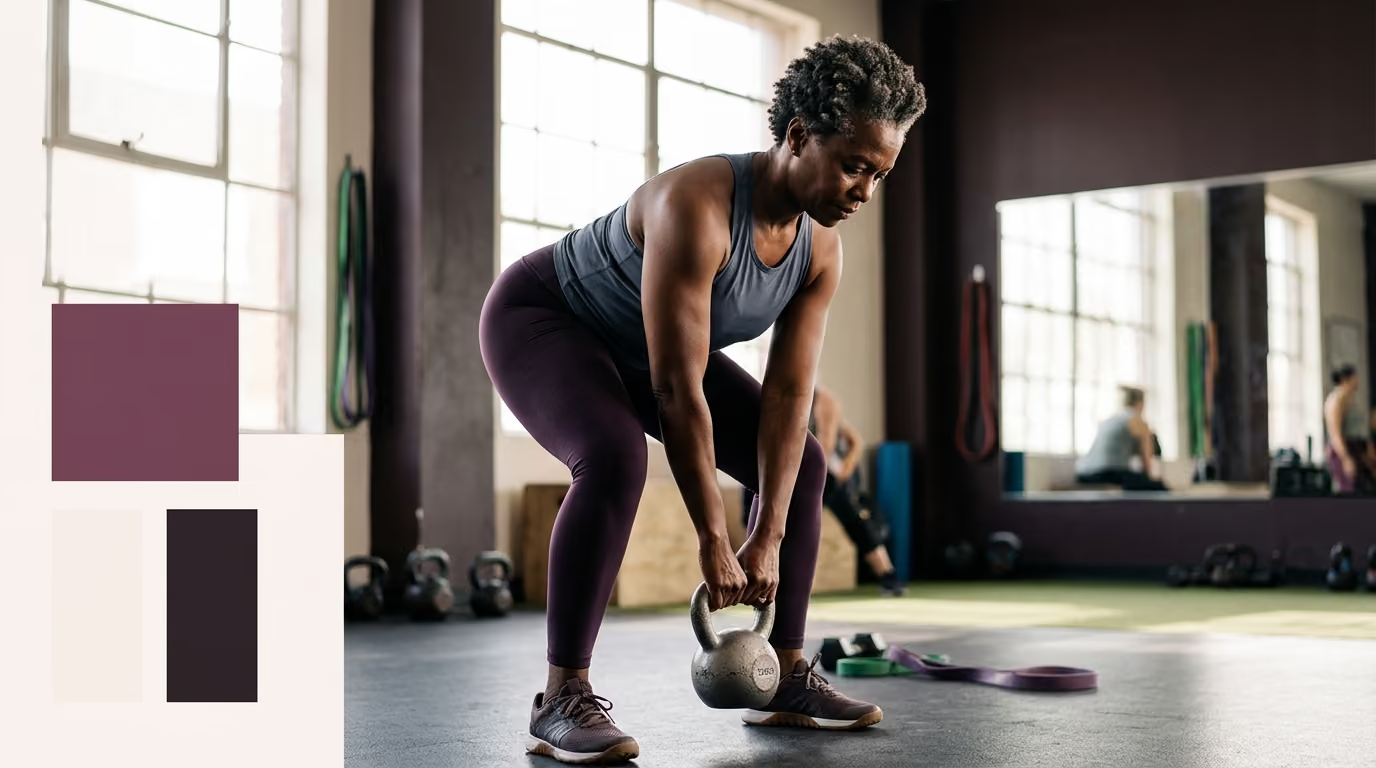

Strength training after 40 helps women build lean muscle, protect bone density, navigate shifting hormones, and master essential movement patterns for lifelong physical capability.





Most fitness advice aimed at women over forty begins with a warning about decline. It suggests that turning forty causes an immediate physical cliff, where muscle vanishes overnight and joints become fragile relics. This framing encourages either fear or frantic overcorrection. Women are told to lift until utter exhaustion to save their metabolism, or warned to avoid heavy objects entirely to protect their joints.
Both extremes miss the reality of midlife physiology. Strength training after forty is not about adopting an extreme athletic identity, chasing punishing soreness, or attempting to look twenty-five again. It is a practical skill that builds physical capability. Lifting weights allows you to carry heavy luggage, climb stairs without knee pain, protect your bone density, and move through the world with confidence.
Building strength does not require complicated routines or hours in the gym. It requires learning basic movement patterns, applying consistent effort, and allowing your body time to adapt. When you approach resistance training as an investment in capability rather than a punishment for aging, consistency becomes sustainable.
The biological value of lifting weights during midlife is supported by extensive research. The World Health Organization recommends that all adults perform muscle-strengthening activities involving all major muscle groups at least two days per week. This baseline guideline applies across the lifespan because muscle tissue directly influences metabolic regulation, physical function, and joint stability.
Systematic reviews examining resistance training in women aged forty-five to eighty confirm significant benefits. Consistent training improves muscle mass, increases maximal force production, and enhances functional independence. These improvements occur across premenopausal, perimenopausal, and postmenopausal stages. The body retains its ability to adapt to resistance training regardless of when you begin.
Mechanical loading from resistance exercise is also critical for skeletal health. Bone tissue adapts to the physical stress placed upon it by muscular contractions and gravity. Controlled trials in postmenopausal women demonstrate that progressive resistance training two to three times per week helps maintain or increase bone mineral density in the lumbar spine and femoral neck.
Resistance training also alters body composition by preserving lean tissue. Research indicates that resistance programs increase lean mass in middle-aged and older women, even when total body weight on a bathroom scale remains unchanged. Gaining muscle improves insulin sensitivity, supports joint health, and raises physical capacity, creating measurable health improvements that standard scales cannot capture.
Midlife is marked by physical transitions that influence how your body handles physical stress and recovery. These shifts are normal adaptations rather than signs of disease. Understanding these changes helps you adjust your training sensibly without fear.
Perimenopause and postmenopause bring fluctuations and eventual declines in ovarian hormones, particularly estrogen and progesterone. Estrogen plays a protective role in muscle protein synthesis, bone remodeling, and collagen maintenance within connective tissues. When estrogen levels decrease, the body may experience a slower rate of muscle repair, changes in tendon elasticity, and higher resting inflammation.
These hormonal changes do not prevent you from building muscle or gaining strength. They simply mean your recovery margin narrows. You might notice that poor sleep, inadequate nutrition, or rapid spikes in training volume cause longer periods of stiffness. Tailoring your training to allow adequate rest between hard efforts helps manage these hormonal shifts. Explore our hormonal transition guidance to understand how these endocrine changes interact with your broader health.
Tendons and ligaments lose some water content and elasticity as the years advance. Articular cartilage inside joints experiences natural wear, which can make knees, hips, or shoulders feel stiff after periods of inactivity. If you jump into high-impact workouts or heavy loads without preparation, connective tissues may complain before your muscles do.
Muscles adapt to resistance training faster than tendons and ligaments. A gradual progression allows your connective tissues to remodel safely alongside your muscular system. Longer warm-ups and controlled tempos protect joint structures while building resilient joint support.
Midlife often coincides with peak professional demands, family caretaking, and fluctuating sleep quality. Night sweats, stress, and busy schedules affect systemic recovery. Your capacity to absorb training stress depends on your overall lifestyle, not just what happens during a workout.
If you slept poorly or spent hours managing intense work demands, your nervous system arrives at the gym partially depleted. Recognizing that recovery is dynamic allows you to adjust workout intensity without abandoning your routine entirely. Building strength is a lifelong practice, so consistency across months matters far more than pushing through acute exhaustion on any single day.
Effective strength training focuses on fundamental movement patterns rather than isolated muscle groups. Humans move by squatting, hinging, pushing, pulling, stepping, and carrying. Training these patterns builds practical strength that translates directly into everyday activities. For more resources on movement and metabolism, browse our midlife strength resources.
Squatting involves bending your hips, knees, and ankles to lower your body and then standing back up. In everyday life, this is how you sit down into a low chair, get out of a car, or stand up from the floor.
Beginners often worry about squatting too deep or hurting their knees. You do not need to squat deeply on day one. Starting with a chair sit-to-stand allows you to learn the pattern with built-in safety. As you build leg strength and hip mobility, you can progress to holding a light weight at your chest.
Key execution points:
The hinge involves folding forward at the hips while maintaining a neutral, supported spine. It targets the posterior chain, including the glutes, hamstrings, and lower back muscles. This is the exact movement used when picking up a laundry basket, lifting a heavy box, or bending to weed a garden bed.
Many beginners confuse the hinge with a squat. In a squat, your knees bend deeply and your torso stays relatively upright. In a hinge, your knees bend only slightly while your hips travel backward, loading the back of your legs.
Key execution points:
Pushing exercises strengthen the chest, shoulders, and triceps. This pattern helps you push open heavy doors, stow carry-on luggage overhead, or push yourself up from the ground.
Pushing can be horizontal, such as a push-up or chest press, or vertical, such as an overhead press. Beginners who find floor push-ups too challenging should avoid dropping to their knees immediately. Performing push-ups with hands elevated on a wall, kitchen counter, or sturdy bench maintains full-body alignment while reducing the load.
Key execution points:
Pulling exercises target the upper and middle back, rear shoulders, and biceps. They balance the forward-slumped posture common with desk work and driving. Strong pulling muscles make it easier to open stuck windows, pull open heavy gates, and maintain upright posture.
Pulling movements include horizontal rows and vertical pull-downs. Using resistance bands, cable machines, or dumbbells allows you to build back strength without straining your neck.
Key execution points:
Single-leg movements train each leg independently, exposing strength imbalances and challenging balance. Walking, stepping onto a curb, and climbing stairs are all single-leg tasks.
Because balance can be a limiting factor, beginners should hold onto a sturdy wall, railing, or pole for support. This removes the fear of falling and lets your leg muscles do the actual work of building strength.
Key execution points:
Carrying involves picking up a load and walking with it under control. It builds grip strength, core stability, shoulder endurance, and balance simultaneously. It directly replicates carrying heavy grocery bags, bags of garden soil, or moving furniture.
Carrying weights is one of the safest and most effective exercises for midlife women. It places minimal shearing stress on joints while demanding full-body coordination.
Key execution points:
True core training is about resisting unwanted motion rather than performing hundreds of crunches. A strong trunk protects your spine when you lift external loads. Exercises like the bird dog, dead bug, side plank, and Pallof press teach your abdominal and back muscles to stabilize your spine under load.
Key execution points:
You do not need a gym membership filled with intimidating barbell racks to build substantial strength. Many different tools provide adequate resistance. Choose the equipment that fits your living space, budget, and comfort level.
Bodyweight exercises use your own mass as resistance. They are accessible, free, and can be done anywhere. Variations like chair squats, wall push-ups, glute bridges, and bird dogs allow you to master technique without handling external iron.
Bodyweight training has limitations. It is difficult to train the pulling pattern effectively with bodyweight alone without specialized equipment like suspension straps. Bodyweight movements can also be hard to scale in small increments, so combining bodyweight with other tools is ideal.
Elastic bands offer an inexpensive, lightweight, and portable option. They are useful for home training and travel. Bands allow you to perform rows, chest presses, lateral walks, and shoulder stability drills safely.
The main challenge with bands is that resistance increases as the band stretches. This means the movement feels hardest at the very top of the range and lightest at the start. Bands can also degrade over time, so inspect them regularly for tears or punctures before use.
Dumbbells and kettlebells are the most versatile tools for home and gym training. They allow each side of your body to work independently, correcting side-to-side strength differences. You can hold them in various positions to change the challenge of a squat, lunge, or press.
A modest set of dumbbells or an adjustable pair gives you everything needed to progress for years. Start with a light pair for upper-body work and a moderate pair for lower-body movements.
Fitness machines provide external stabilization and guide you through a fixed path of motion. They are valuable for beginners who feel uncoordinated, lack balance, or feel intimidated by free-weight areas.
Using a leg press, chest press, or lat pulldown machine lets you load your muscles safely while you build baseline strength. Machines are not inferior to free weights; they are effective tools that allow you to work hard with minimal technical risk.
A successful strength program is built on simplicity, repeatability, and gradual progression. Complex routines with dozens of exercises cause decision fatigue and unnecessary muscle soreness.
The most practical starting routine consists of two full-body sessions per week, separated by at least forty-eight hours of rest. Each session should take thirty to forty-five minutes and feature five to seven multi-joint movements. This frequency meets public health guidelines while leaving plenty of room for recovery and life responsibilities.
Alternate between two distinct workouts across the week. For example, perform Session A on Tuesday and Session B on Friday or Saturday.
You do not need to train to muscular failure where you cannot complete another repetition. Training to complete failure causes excessive fatigue, increases soreness, and breaks down technique.
Instead, use the concept of Repetitions in Reserve (RIR). RIR measures how many additional, clean repetitions you could have performed before your technique broke down:
Beginners should complete most sets at 2 to 4 RIR. This builds strength, stimulates muscle tissue, and protects your joints without causing lingering exhaustion.
To keep getting stronger, you must apply progressive overload, which means gradually increasing the demands placed on your muscles. The double-progression model is the clearest way for beginners to advance:
Progression does not always mean adding weight. You can also progress by improving your control, slowing down the lowering phase, using a slightly larger range of motion, or finishing the same work with less effort.
Recovery is where your body repairs tissues and builds new strength. Without adequate recovery, training becomes a source of chronic fatigue rather than renewal.
Delayed-onset muscle soreness (DOMS) refers to the muscle stiffness and tenderness that appears twenty-four to forty-eight hours after an unfamiliar workout. It is caused by microscopic mechanical disruption in muscle fibers and the subsequent inflammatory repair process.
Experiencing mild soreness when you start lifting is completely normal. However, severe soreness that leaves you unable to sit down comfortably or walk down stairs is a sign that the workout exceeded your current capacity. Soreness is not a badge of honor or an accurate measure of a workout's effectiveness. As your body adapts over three to four weeks, post-workout soreness will diminish significantly.
Learning the difference between normal training fatigue and joint pain is an important skill:
Normal Muscle Soreness:
Warning Signs of Strain or Joint Irritation:
If you encounter sharp or joint-centered pain, stop that specific exercise immediately. Modify the range of motion, reduce the weight, or swap it for a comfortable alternative.
Your physical readiness varies from day to day based on sleep quality, work stress, and cycle changes. Using a simple traffic-light approach helps you adapt your workout rather than skipping it entirely:
You slept well, energy is normal, and your joints feel comfortable.
Action: Follow your planned workout, aiming to progress repetitions or load as scheduled.
You had broken sleep, feel moderate stiffness, or are managing high mental stress.
Action: Complete the session, but reduce the weights by ten to fifteen percent, perform one fewer set per exercise, and rest longer between sets. Keep effort around 3 to 4 RIR.
You are fighting an illness, experiencing acute joint pain, feeling dizzy, or suffering from severe exhaustion.
Action: Skip the lifting session. Go for a gentle walk, do light stretching, or prioritize rest and sleep.
Strength training provides the stimulus for your body to adapt, but nutrition provides the building blocks. You do not need an extreme diet to support your training. Focusing on adequate protein, hydration, and overall energy balance is sufficient. For detailed dietary strategies, read our nutrition and metabolic health insights.
Muscle tissue is constantly breaking down and rebuilding. Resistance training stimulates muscle protein synthesis, and dietary protein provides the amino acids necessary to repair and construct that muscle tissue.
Research reviews in sports nutrition recommend an intake between 1.2 and 2.0 grams of protein per kilogram of body weight per day for active individuals. For a woman weighing 70 kilograms (roughly 154 pounds), this translates to approximately 84 to 140 grams of protein daily.
Reaching the higher end of this range is helpful if you are working to change your body composition, while the middle of the range supports general health and recovery. If you have underlying kidney conditions, consult your physician for individualized protein guidance.
Distributing your protein across three or four meals throughout the day supports steady muscle protein synthesis. Simple food-based options include:
Protein powders can be convenient after a workout, but whole foods provide valuable micronutrients, vitamins, and minerals that powders lack.
Muscle tissue is roughly seventy-five percent water. Even mild dehydration can reduce muscular force production, impair coordination, and worsen feelings of fatigue. Drink water consistently throughout the day, aiming for pale-colored urine as an easy baseline check.
Avoid severe calorie restriction while starting a resistance program. Lifting weights requires energy, and chronically underfueling leads to poor recovery, elevated stress hormones, and loss of lean muscle. Eating balanced meals with complex carbohydrates, quality protein, and healthy fats gives your body the fuel it needs to build strength.
Strength training is adaptable to almost any physical limitation. If you manage an ongoing health condition, tailored modifications allow you to train safely and productively.
A diagnosis of low bone density is not a reason to avoid lifting weights. On the contrary, progressive resistance training is one of the most effective non-pharmacological tools to support bone health. Bone adapts to the mechanical pull of muscles and the load of resistance.
If you have osteoporosis or a history of spinal fractures, work with a knowledgeable physical therapist or exercise specialist. General modifications include:
Joint cartilage wear can cause morning stiffness, swelling, and aching. Resistance training helps osteoarthritis by strengthening the muscles surrounding the joint, which absorbs impact forces and stabilizes movement.
When training with arthritis:
Many women experience pelvic floor concerns in midlife, including stress urinary incontinence or feelings of pelvic heaviness. These symptoms are common, but they should not be ignored or accepted as an inevitable consequence of aging.
If you notice leakage during lifting:
Starting something new in midlife often means unlearning decades of fitness culture misinformation. Clearing away these misconceptions frees you to focus on what actually works.
Building substantial muscle bulk requires years of high-volume training, dedicated calorie surpluses, and specific genetics. Women naturally produce significantly lower levels of anabolic hormones than men.
Strength training will make your muscles firmer, improve your posture, and create a leaner, more compact physique. Muscle tissue is denser than fat tissue, meaning you can lose inches and fit better in your clothes while the scale stays stable.
Many women believe they must run or do intense cardio to "earn" the right to lift weights. This approach often leads to overuse injuries, fatigue, and burnout.
You do not need baseline cardiovascular fitness to begin lifting. Lifting weights at a controlled pace builds muscular strength and cardiovascular capacity simultaneously. Walking daily combined with two weekly lifting sessions provides a balanced foundation for midlife health.
Muscle tissue remains responsive to mechanical tension across your entire lifespan. Clinical trials routinely show women in their seventies, eighties, and nineties gaining measurable strength, improving balance, and rebuilding lost muscle through resistance training. Starting at forty, fifty, or sixty gives you decades to build a strong, capable body.
These illustrative examples show how different women adapt strength training to their unique lives.
Sarah, 48, had not exercised regularly since her late twenties. Her primary challenges were tight hips, weak upper back muscles, and limited time.
Approach: She began with two 30-minute home workouts weekly using bodyweight and light resistance bands. She focused on chair sit-to-stands, band rows, and elevated push-ups. By keeping her sessions brief and manageable, she established a consistent habit without triggering severe muscle soreness.
Elena, 53, wanted to build bone density but felt uncomfortable in the free-weight section of commercial gyms.
Approach: She used fixed-path weight machines during quiet morning hours. She followed a written plan covering the leg press, chest press, and seated cable row. The machines gave her stability and clear seat adjustments, allowing her to build movement confidence before adding free-weight dumbbell exercises.
Karen, 44, experienced frequent perimenopausal sleep disruptions and unpredictable energy levels.
Approach: Instead of forcing herself through rigid, exhausting workouts, Karen used the traffic-light system. On good days, she pushed her dumbbell loads. On days following broken sleep, she reduced her sets, kept weights moderate, and focused on movement quality. This flexibility allowed her to train consistently without burning out.
For practical steps on maintaining self-trust through physical and lifestyle changes, explore our midlife confidence practices.
Relying solely on a traditional bathroom scale is one of the fastest ways to derail your motivation. Scales measure total body mass, including water, bone, organs, muscle, and fat. They cannot tell you if you gained half a pound of bone and muscle while losing half a pound of body fat.
Track your progress using functional, meaningful markers:
Keep a simple notebook or phone log to record your exercises, the weights used, and how the sets felt. Reviewing your log after eight weeks provides undeniable proof of your growing strength. You can also explore our broader strength and body composition articles for further insights into tracking functional health.
This four-week orientation plan is designed to help you build consistency, learn movement mechanics, and establish training confidence.
While the physiological benefits of resistance training are well established, it is helpful to recognize where current scientific evidence has boundaries.
Much of the older exercise physiology literature was conducted primarily on young male cohorts. While research on peri- and postmenopausal women has expanded significantly in recent years, optimal exercise volume, load distribution, and recovery timing across different menopausal stages are still being actively investigated. Individual responses to resistance training vary widely based on genetics, baseline fitness, metabolic health, and nutritional status.
Furthermore, resistance training is not a universal cure for every midlife symptom. Lifting weights will not eliminate vasomotor symptoms like hot flashes, nor does it guarantee rapid fat loss on its own. Resistance training reliably increases muscular strength and preserves lean tissue, but changes in body fat depend on total energy intake, daily non-exercise movement, sleep duration, and hormonal factors.
Be cautious of commercial fitness programs that market heavy lifting as an anti-aging miracle or guarantee a complete metabolic reset. Approach resistance training for what the evidence genuinely supports: an effective, reliable tool for building strength, protecting bone mass, and maintaining lifelong physical capability.
Strength training is an enduring investment in your future autonomy, allowing you to meet the physical demands of midlife with power, stability, and lasting confidence.

Follow Refemina for research-led resources on hormonal change, strength, metabolism, nutrition, skin, intimate wellbeing and confidence through midlife.


Keep learning about the changes that shape energy, strength, confidence and wellbeing through midlife.
Explore Resources