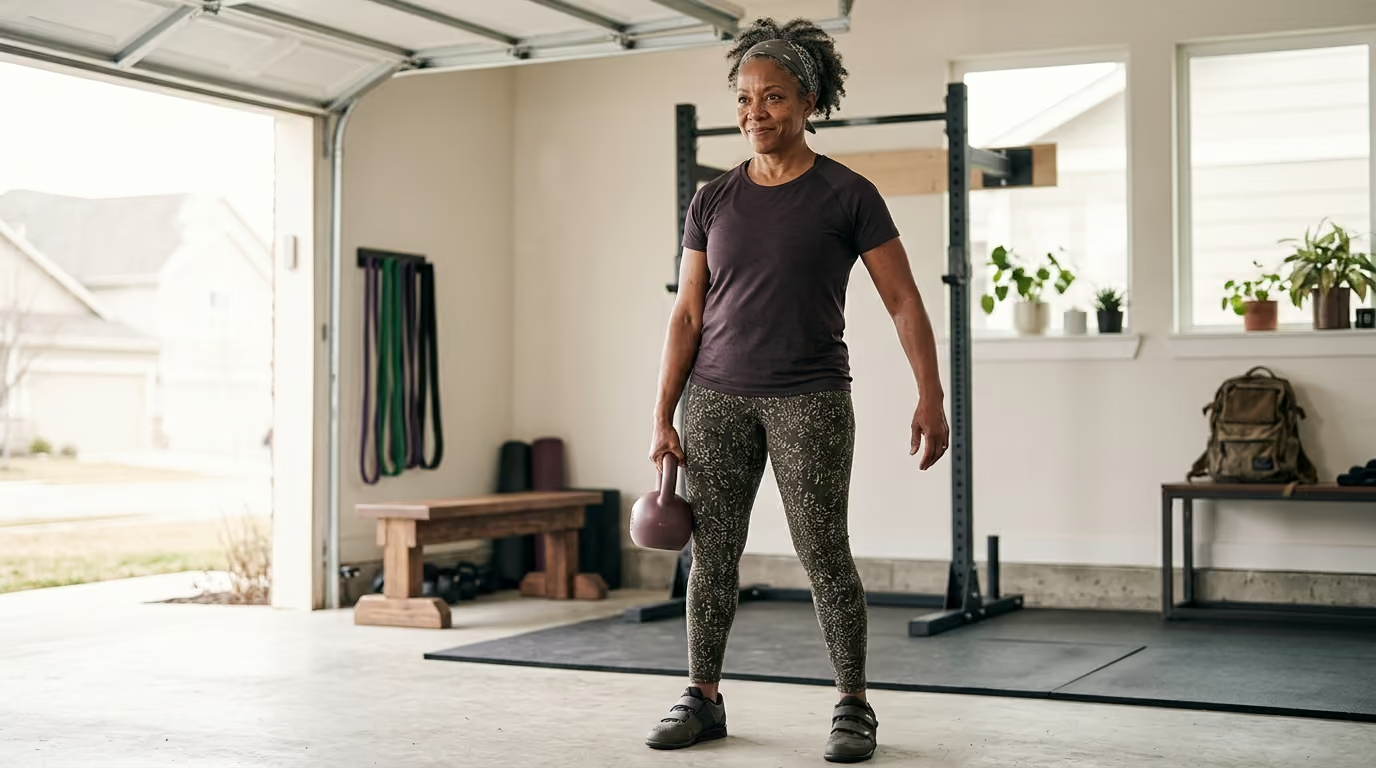

Strength training in midlife builds a resilient body and preserves daily function through evidence-based movement patterns and progressive weekly workout routines.





You are lifting a heavy suitcase into an overhead luggage compartment, carrying bags of soil across the garden, or standing up from the living room floor. You might notice a subtle hesitation that was not there a decade ago. Perhaps your knees feel slightly less stable under load. Maybe your grip tires faster, or your lower back complains when you pick up an awkward parcel.
These small physical moments are not signs of inevitable decline. They are direct signals about your current force production, joint stability, and movement habits. Midlife introduces real physiological shifts, yet your muscular and skeletal systems retain a remarkable capacity to adapt, rebuild, and strengthen when given the right mechanical stimulus.
Building physical capability in midlife does not require punishing gym routines, extreme fatigue, or complicated acrobatics. A dependable program focuses on fundamental human movement patterns: squatting, hinging, pushing, pulling, carrying, bracing, and rotating. When you train these patterns progressively, you build a body that feels capable, resilient, and prepared for daily life.
A large body of clinical research confirms that skeletal muscle remains responsive to mechanical load across the entire adult lifespan. Systematic reviews demonstrate that structured resistance training produces an average 18.4 percent increase in muscle strength and a 26.68 percent improvement in the rate of force development in healthy older adults. These meaningful physical gains occur in structured programs lasting anywhere from four to sixteen weeks.
Meta-analyses examining adults aged 50 and older report absolute strength increases ranging from 9.8 to 31.6 kilograms across fundamental compound exercises like leg presses, chest presses, and lat pulldowns. Training intensity plays a clear role in these outcomes. While moderate loads build functional capacity, higher-intensity resistance training consistently produces greater improvements in maximal force production when introduced safely.
Strength training provides systemic health protections that extend far beyond lifting performance. A systematic review on cardiometabolic outcomes found that medium-term resistance training significantly reduces fasting insulin levels and decreases insulin resistance. Dynamic loading also provides mechanical signals that help preserve skeletal integrity. Systematic reviews in postmenopausal women confirm positive effects on bone mineral density at the lumbar spine, femoral neck, and radius.
The World Health Organization establishes a clear baseline for adult physical health. The guidelines recommend that all adults perform muscle-strengthening activities involving all major muscle groups on at least two days each week. They also advise 150 to 300 minutes of moderate-intensity aerobic activity weekly. For adults aged 65 and older, public health guidance adds multidirectional balance and functional strength training on three days per week to support mobility and reduce fall risks.
Midlife brings gradual shifts in hormonal status, tissue elasticity, and neuromuscular recovery. Estrogen fluctuations during perimenopause and the years after menopause influence collagen turnover, muscle protein synthesis, and bone remodeling. Resting metabolic rate can drift downward when lean muscle mass is lost through inactivity, altering body composition over time.
These biological changes do not mean your body is failing. Muscle loss across adulthood is driven heavily by reduced physical challenge and decreased high-threshold motor unit recruitment. When you stop lifting challenging loads, your nervous system reduces its ability to recruit fast-twitch muscle fibers quickly. This neuromuscular change explains why power and rapid force development often decline faster than basic muscular endurance.
Medical consensus groups distinguish between muscle size, muscle strength, and functional performance. The European Working Group on Sarcopenia in Older People identifies low muscle strength as the primary characteristic of sarcopenia. A clinical diagnosis is confirmed when low muscle quantity or poor muscle quality is present. Poor physical performance indicates a more advanced stage of functional decline.
Screening metrics used in clinical research offer helpful reference points. Probable sarcopenia is identified by a handgrip strength below 16 kilograms in women or below 27 kilograms in men. A five-times-sit-to-stand test taking longer than 15 seconds or a comfortable gait speed slower than 0.8 meters per second also flags reduced capability. These diagnostic cutoffs show that strength is a primary vital sign for lifelong independence.
Understanding different strength qualities helps you design a balanced routine:
Building muscle tissue through hypertrophy requires mechanical tension and training volume. The updated American College of Sports Medicine guidance notes that accumulating approximately 10 weekly sets per target muscle group optimizes muscle growth over time. Beginners and returning lifters can achieve substantial gains in functional capacity with much lower initial volumes.
Scientific data translates directly into your everyday experience of energy, stability, and confidence. True functional strength is not measured by gym aesthetics or body size. High muscle mass does not guarantee good balance, and a lean physique does not automatically produce movement confidence. Real capability means possessing physical reserve beyond the minimum requirements of your daily routine.
When you develop strength across major movement patterns, ordinary tasks stop feeling like maximum physical efforts. Carrying heavy bags from the car becomes a comfortable submaximal carry rather than a strain on your wrists and lower back. Standing up from a low garden chair becomes an effortless leg drive rather than a struggle requiring momentum and hand support.
Physical reserve transforms your psychological relationship with your body. Many midlife women report feeling disconnected from their physical capabilities after years of prioritizing cardiovascular exercise or restrictive dieting. Progressive strength training shifts your focus from shrinking your body to expanding what your body can accomplish. This physical self-efficacy carries over into workplace stamina, recreational sports, travel, and personal posture.
Investing in muscle mass also creates a powerful metabolic buffer. Skeletal muscle serves as the primary site for glucose clearance and disposal in the human body. By preserving and expanding lean tissue through our comprehensive strength, body composition, and metabolism resources, you improve metabolic flexibility and support long-term energy balance without extreme dietary restriction.
Effective training does
not require dozens of complicated exercises. It organizes your routine around seven fundamental patterns that mirror daily human movement: squatting, hinging, pushing, pulling, carrying, bracing, and rotating.
The squat involves coordinated flexion and extension through the hips, knees, and ankles. It develops the quadriceps, gluteal muscles, and lower back, directly supporting your ability to stand up, climb steep hills, and lower yourself under control.
The exercise ladder begins with accessible variations:
Select a variation that permits stable three-point foot contact across your heel, big toe, and pinky toe. If you experience knee discomfort, adjust your foot stance width, point your toes slightly outward, or raise your box target. A higher box is a smart tool to manage joint stress while training leg drive.
The hinge emphasizes movement through the hips while keeping the spine in a stable, neutral posture. It targets the posterior chain, including the hamstrings, glutes, and spinal erectors, which protect your back when lifting objects from the ground.
The exercise progression moves from basic mechanics to loaded lifts:
A common pitfall is turning a hinge into a squat by bending the knees too early. Focus on pushing your hips backward as if closing a car door with your glutes while keeping your shins relatively upright.
Pushing exercises build force in the chest, anterior shoulders, triceps, and anterior core. This pattern divides into horizontal pushing and vertical pushing, both of which support upper-body tasks like opening heavy security doors or placing luggage overhead.
The horizontal and vertical progressions include:
If overhead pressing causes shoulder pinching, prioritize landmine presses or incline dumbbell presses. These variations allow natural scapular movement without forcing the shoulder into uncomfortable end-range positions.
Pulling movements strengthen the upper back, latissimus dorsi, rhomboids, rear deltoids, and biceps. They balance out the forward-leaning postures of modern life and support healthy scapular mechanics during lifting tasks.
The pulling continuum ranges from fully supported options to bodyweight challenges:
Aim to balance your pressing and pulling volume across your weekly schedule. For every set of pressing you perform, complete at least one dedicated set of horizontal or vertical pulling to maintain balanced shoulder mechanics.
Loaded carries are among the most practical exercises in strength training. They train dynamic grip strength, lateral hip stability, core rigidity, and upright postural control under changing foot contacts.
The carry progression varies by load placement and symmetry:
Choose a clear, unobstructed path of 15 to 30 meters. Walk with smooth, deliberate steps without letting the weights swing or bang against your legs. Put the load down with a controlled hip hinge rather than rounding your back at the end of a set.
Bracing describes the ability of the trunk musculature to resist unwanted spinal movement when external forces act on the body. This involves resisting extension, lateral bending, and unwanted rotation while allowing normal, rhythmic breathing.
Effective bracing progressions include:
Bracing is not about holding your breath until your face turns red. It is the skill of maintaining muscular stiffness around your spine while continuing to breathe shallowly behind your abdominal shield.
Human movement depends on the ability to generate, transfer, and control rotational forces through the hips and trunk. Many daily injuries occur during combined bending and twisting motions, making rotational training a valuable component of midlife resilience.
The rotation progression includes both dynamic and anti-rotational exercises:
Distinguish between active rotation through the hips and upper back and uncontrolled twisting through the lumbar spine. If you have a history of disc herniation or vertebral issues, focus primarily on anti-rotation movements like the Pallof press.
Creating an effective program requires matching your weekly schedule to your current recovery capacity and movement history. A practical strength framework uses a simple decision process:
For practical programming templates and metabolic insights, review our articles on strength, body composition, and metabolism to help organize your week.
A two-day routine satisfies the World Health Organization adult baseline and fits busy schedules:
Distributing your training volume across three weekly sessions allows shorter workouts and greater exercise variety:
Beginners achieve solid adaptations using 1 to 3 working sets of 8 to 12 controlled repetitions per exercise. Choose a starting load that allows you to complete every repetition with clean, repeatable mechanics. ACSM progression guidelines recommend increasing the load by approximately 2 to 10 percent once you can complete one or two extra repetitions beyond your target range on all sets.
Use the double-progression method to build strength systematically:
Manage your proximity to failure carefully. Novices should complete sets with approximately 3 to 5 technically sound repetitions left in reserve. Intermediate lifters can work closer to failure, finishing sets with 1 to 3 repetitions in reserve. Never sacrifice technical precision for an extra repetition.
Allow adequate rest between sets. Take 1 to 2 minutes of rest between moderate accessory exercises, and 2 to 3 minutes between demanding compound movements like squats and deadlifts. Adequate rest allows your nervous system to recover, ensuring high force production on every set.
Adjust your training when life demands shift. If poor sleep, professional stress, or travel reduces your recovery, apply an autoregulation strategy. Reduce your total working sets, stop farther from failure, or choose a simpler exercise variation. Modifying a session keeps your routine consistent while preventing accumulated fatigue.
Every midlife woman begins her training journey from a distinct physical background. These illustrative models show how to adapt the framework to specific starting points.
A mid-40s professional spends long hours at a desk, notices hip stiffness, and feels nervous about lifting weights. Her priority is establishing two predictable 30-minute sessions each week using stable, low-complexity movements.
Her entry-level program includes:
Her initial goal is consistency and movement confidence rather than rapid load increases. Within eight weeks, standing up feels easier and her lower back tolerates long workdays with less fatigue.
A woman in her early 50s played collegiate sports but has not lifted weights consistently for a decade. She possesses good movement awareness but carries unrealistic expectations about her current tendon and joint tolerance.
Her strategy focuses on rebuilding connective tissue resilience:
Her primary challenge is pacing. By treating her return as a fresh foundation, she avoids tendon irritation and builds durable strength.
A 58-year-old woman wants to support her skeletal health after a routine bone density scan shows mild osteopenia. She has no history of fractures and wants to build physical stability.
Her program emphasizes progressive mechanical loading and multidirectional balance:
Dynamic loading across her hips and spine provides osteogenic signals. She builds structural strength while improving her balance and reducing future fall risks.
A 48-year-old recreational runner logs 25 miles per week but experiences recurring hip aches and upper-body fatigue during long runs. She has excellent cardiovascular stamina but limited absolute strength.
Her strategy introduces two strength sessions that support running economy:
Her strength training reinforces hip stability and foot-ankle stiffness, improving her running stride without causing excessive fatigue.
A woman carrying substantial body mass wants to build strength and mobility but finds floor exercises and deep knee flexion uncomfortable. Her program prioritizes joint-friendly, off-the-floor movements with clear progression.
Her foundational routine includes:
Elevating the work surface avoids awkward floor transitions while allowing her to train with meaningful resistance. She builds strength and functional confidence without unnecessary joint irritation.
A 52-year-old executive and caregiver struggles to fit long gym visits into her weekly schedule. She needs a time-efficient, minimal effective dose that preserves her capability.
Her 25-minute full-body circuit includes:
Moving through paired exercises with structured rest keeps her heart rate up and completes her training in under half an hour. She meets her health baseline without adding calendar stress.
Misinformation about women's strength training often creates unnecessary barriers to getting started. Clearing up these common myths helps you train with clarity and confidence.
Chronological age does not make heavy lifting unsafe. Systematic reviews show that adults in their 80s and 90s build muscle size and strength in response to progressive resistance training. The true safety factors are appropriate exercise selection, sound lifting technique, progressive loading, and adequate recovery. Starting with manageable loads and progressing gradually makes lifting one of the safest physical activities you can pursue.
Exercise machines provide guided movement paths that stabilize the load, allowing you to train target muscles with minimal balance demands. While free weights train balance and stabilizer muscles, machines are valuable tools for beginners, individuals managing joint pain, and those looking to train close to muscular fatigue safely. A well-rounded program can combine both free weights and machines effectively.
Training to complete muscular failure, where a repetition cannot be finished despite maximal effort, is not necessary for building strength or muscle mass. For midlife lifters, training to failure increases joint stress, degrades lifting mechanics, and extends recovery times. Finishing most sets with 2 to 4 repetitions in reserve provides an effective stimulus while keeping fatigue manageable.
The term "toning" simply describes having developed muscle mass paired with moderate body fat levels. Muscle tissue only does two things in response to training: it grows larger or it shrinks from disuse. Lifting very light weights for 30 repetitions builds local endurance, but it does not provide the mechanical tension needed to build bone density, absolute strength, or muscle reserve. Midlife women benefit from lifting moderate to heavy weights across standard repetition ranges.
You do not need gymnast-level flexibility before you pick up a weight. Properly selected resistance exercises through a comfortable range of motion actively improve your active mobility. Using a goblet squat or an elevated deadlift teaches your nervous system to stabilize your joints at end ranges, building mobility and strength simultaneously.
Adequate dietary protein is essential for muscle recovery, but nutrition cannot replace mechanical tension. Research shows that protein supplementation supports lean body mass gains primarily when paired with progressive resistance training. For adults aged 65 and older, daily protein intakes of 1.2 to 1.59 grams per kilogram of body weight support lean tissue, while younger adults may benefit from 1.6 grams per kilogram. Learn more about balanced fueling strategies in our nutrition and weight management guidance.
Resistance training is safe and beneficial for most midlife women. Certain symptoms, medical conditions, and clinical histories warrant professional medical evaluation and individualized clearance before beginning or progressing a program.
Under American College of Sports Medicine preparticipation screening guidance, inactive individuals with known cardiovascular, metabolic, or renal disease should obtain clinical clearance before beginning a vigorous exercise routine. If you experience any of the following symptoms during or after exercise, stop training and seek medical evaluation:
Individualized exercise modification is important if you have diagnosed osteoporosis, a history of vertebral fractures, or pelvic floor dysfunction. Women with low bone density should work with a qualified physical therapist to learn safe spinal alignment and avoid loaded end-range spinal flexion or aggressive twisting. Pelvic floor symptoms, including stress urinary incontinence or feelings of pelvic heaviness, can be managed by adjusting your breathing patterns, modifying lifting stances, and avoiding excessive intra-abdominal pressure.
Explore our comprehensive perimenopause and menopause health resources for evidence-based context on navigating systemic health, hormonal changes, and medical conversations during midlife.
While the benefits of resistance training are well established, current scientific literature has specific boundaries that deserve transparent discussion. Many published resistance-training trials in older adults run for short durations of 8 to 24 weeks. These studies demonstrate clear short-term improvements in strength, insulin sensitivity, and functional capacity, but long-term randomized trials tracking continuous training across multiple decades remain rare.
The magnitude of bone mineral density improvement also shows individual variation across clinical trials. Resistance training consistently preserves bone mass and slows postmenopausal bone loss, but it does not always produce large increases in bone density at every skeletal site. Training protocols that build spinal density may show smaller effects at the femoral neck or radius, depending on the specific loading vectors and exercise selections used.
Commercial fitness marketing frequently overstates the speed and ease of body recomposition. Social media programs often promise dramatic physical transformations in 30 days using proprietary routines or unregulated supplements. High-quality scientific evidence shows that meaningful muscle hypertrophy and structural adaptations require months of consistent training, progressive mechanical overload, adequate recovery, and balanced nutrition.
Finally, optimal training volume varies between individuals based on genetics, sleep quality, psychological stress, and nutritional intake. General guidelines provide a dependable starting framework, but personal trial and careful tracking remain necessary to discover your own ideal balance between training stress and recovery capacity.
Measuring your physical progress should extend beyond the bathroom scale. Changes in body weight do not distinguish between muscle tissue, body water, and fat mass, making scale weight an incomplete metric for strength adaptations.
Track your capability using a function-first hierarchy:
Consider using simple functional benchmarks every 8 to 12 weeks. Count how many clean sit-to-stands you can complete from a standard chair in 30 seconds. Time how long you can comfortably hold an unassisted single-leg balance stand on each side. Track the distance you can walk with a suitcase carry using a challenging, safe weight.
These real-world metrics provide clear feedback about your physical reserve. When your functional performance trends upward, you know your training program is building genuine capability. Discover additional clinical and lifestyle tools across our full collection of midlife health resources.
Return to this framework whenever your weekly routine stalls, your life schedule shifts, or you are returning to exercise after an illness, injury, or travel break. Use the movement continuum to adjust your exercise selections, reset your progression ladder, or scale back to a dependable minimum effective dose.
Building a capable, resilient body in midlife is not about pursuing athletic perfection or fighting natural aging. It is a lifelong physical practice of giving your body the mechanical signals it needs to stay strong, capable, and confident for decades to come.

Follow Refemina for research-led resources on hormonal change, strength, metabolism, nutrition, skin, intimate wellbeing and confidence through midlife.


Keep learning about the changes that shape energy, strength, confidence and wellbeing through midlife.
Explore Resources