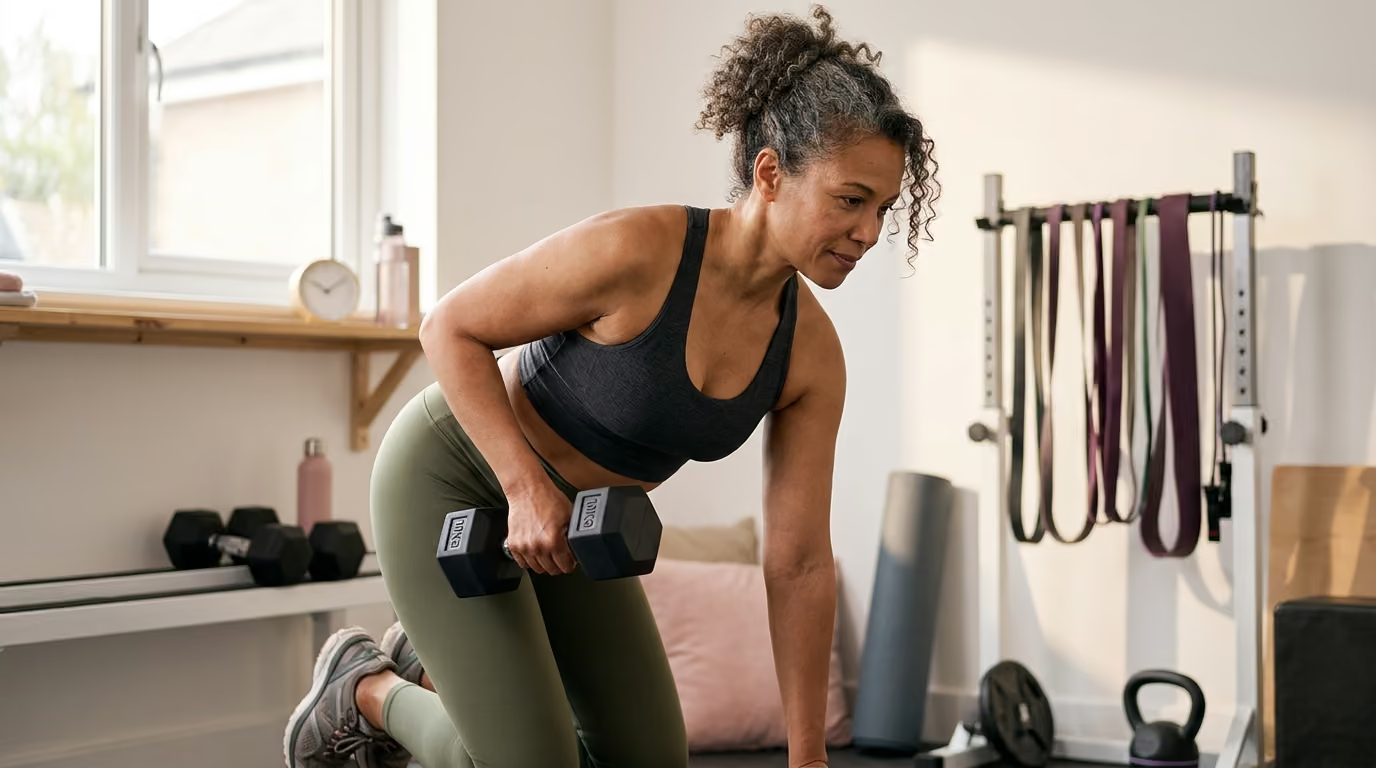

A time-efficient strength plan for midlife women uses fundamental movement patterns and short workouts to build muscle, protect bones, and sustain functional fitness.





You stand in front of two dumbbells on a Tuesday morning, looking at a clock that gives you exactly eighteen minutes before your first call. Your calendar is full, your energy is variable, and the elaborate hour-long workout plan you saved online feels completely disconnected from your morning reality. Many women abandon strength training not because they lack discipline, but because they believe a session must be long to be effective.
Research paints a much more practical picture. Public health guidelines from the World Health Organization recommend muscle-strengthening activities involving all major muscle groups on at least two days per week. Evidence shows that even low-volume resistance training produces meaningful improvements in strength, functional physical capability, and body composition. You do not need complex daily programs to build physical resilience in midlife. A short, repeatable routine performed consistently beats an elaborate program that rarely happens.
The physical shifts that occur around perimenopause and postmenopause often prompt women to re-examine their exercise habits. Natural fluctuations in estrogen influence how your body distributes fat, maintains lean muscle mass, and repairs connective tissue. Lean muscle mass tends to decline with age if it is not actively challenged through resistance.
These physiological shifts do not mean your body stops responding to exercise. Systematic reviews show that healthy postmenopausal women gain upper and lower body strength when they engage in regular resistance training. Muscle tissue retains its capacity to adapt, repair, and grow stronger when given a clear physical stimulus. Understanding how your body responds during this stage helps you make informed choices without feeling overwhelmed by navigating midlife hormonal shifts.
Bone mineral density also experiences age-related changes, making mechanical loading through lifting weights particularly useful. Meta-analyses demonstrate that regular dynamic resistance exercise supports bone mineral density in the lumbar spine, total hip, and femoral neck among postmenopausal women. Muscle strength and bone stiffness work together to protect your joints and preserve functional independence.
Body weight on a standard scale rarely reflects these underlying structural improvements. Resistance training often reduces fat mass while preserving or building lean tissue. As a result, your clothes may fit differently and your balance may improve even if the scale remains static.
Understanding training volume helps you plan realistic workouts. Training volume refers to the total work completed, often measured as hard sets per movement pattern each week. To select the right dose for your schedule, consider three distinct levels of commitment:
This is the smallest volume of exercise required to build or preserve strength. Research examining low-volume resistance training indicates that even one set per exercise performed one to three times weekly can generate strength gains. This low-dose approach keeps your routine moving during demanding travel, high stress, or seasonal chaos.
This is a sustainable workload that produces continuous, measurable progress for most beginners and intermediate exercisers. It typically involves two to three brief sessions each week. It provides enough volume to encourage muscle growth and structural adaptation without requiring hours in the gym.
This higher volume of work may yield faster or more specific body composition changes. However, it demands substantially more time, recovery capacity, nutrition management, and schedule flexibility.
A fifteen-minute workout is a legitimate strength session rather than a compromise. It acts as a reliable floor for your habits rather than a ceiling on your potential. Short sessions keep your neurological system familiar with heavy patterns and maintain your momentum.
Building a time-efficient workout requires focusing on basic movement patterns rather than isolating individual muscles. Isolating biceps or calves takes too much time when your calendar is tight. Training patterns allows you to work multiple muscle groups simultaneously while building functional capability for daily life. You can review detailed guides in our strength and muscle articles section.
Knee-dominant patterns build force through your quadriceps, glutes, and hips. Examples include sit-to-stand movements, bodyweight box squats, dumbbell goblet squats, and split squats. These movements translate directly to standing up from deep chairs, climbing stairs, and stepping off curbs safely.
Hip-dominant patterns target your posterior chain, including your glutes, hamstrings, and lower back. Examples include Romanian deadlifts, kettlebell deadlifts, and hip thrusts. Mastering the hip hinge teaches you to pick heavy items off the floor using your hips rather than bending through your spine.
Upper-body pushing movements target your chest, front shoulders, and triceps. Examples include incline push-ups against a kitchen counter, dumbbell bench presses, and overhead presses. These actions preserve your ability to push open heavy doors and stow luggage overhead.
Upper-body pulling movements strengthen your upper back, rear shoulders, and biceps. Examples include single-arm dumbbell rows, seated cable rows, and resistance band pulls. Pulling exercises support posture and balance out daily desk work.
Carrying and bracing exercises build trunk stiffness, core stability, and grip strength. Examples include farmer carries with two weights, suitcase carries with one weight, dead bugs, and side planks. Carrying heavy items builds practical endurance for daily errands.
This pattern involves single-leg stability and controlled dynamic movement. Examples include step-ups, single-leg balancing, and medicine ball passes. World Health Organization guidance highlights balance and functional training as key components for maintaining mobility across your lifespan.
Prioritize your biggest compound movements first when time is limited. If you only have ten minutes, choose one lower-body movement, one upper-body push, and one upper-body pull. A goblet squat, a dumbbell row, and an incline push-up cover most of your major muscle groups in three simple choices.
A fifteen-minute strength plan works when you execute high-value movements with clear effort and minimal wasted time. Warm up quickly by performing light repetitions of your first movement rather than spending ten minutes on a treadmill. Choose one of the following structured options based on your equipment and preferences.
Perform two to three rounds of this circuit with minimal rest between exercises. Rest for sixty seconds after completing each round.
Alternate between two distinct exercises, completing two rounds of each pairing.
Pairing 1:
Pairing 2:
Pick three core movements: a squat variation, a pull variation, and a push variation. Perform one light warm-up set of five repetitions to practice the form. Then, perform one single hard set of 8 to 12 repetitions, stopping when you have two good repetitions left in reserve. Record your repetitions and load before moving immediately to the next exercise.
Thirty minutes gives you enough time for a thorough full-body routine. You can include four to six exercises, rest longer between sets, and add a core or carrying exercise at the end. Browse our midlife health resources to find movement variations that fit your equipment setup.
Block A:
Block B:
Finisher:
Pairing non-competing exercises saves time without lowering performance. A lower-body exercise paired with an upper-body exercise gives your legs time to recover while your back or chest works. Avoid pairing two heavy lower-body exercises back to back, as this causes excessive systemic fatigue.
A two-day full-body routine represents a highly practical structure for busy schedules. Training twice weekly on non-consecutive days satisfies World Health Organization guidelines while leaving five days for rest, walking, or life responsibilities. Space your workouts with two to three days of recovery in between, such as Monday and Thursday or Tuesday and Saturday.
If you are a beginner, perform only one or two sets per exercise for the first three weeks. Focus on mastering control, range of motion, and smooth breathing. Increase to three sets only when you feel fully recovered between sessions.
Selecting the correct weight can feel confusing if you do not know your maximum capacity. You do not need to test heavy one-repetition maximums to find the right training load. Effort-based scales help you select weights safely and effectively.
Repetitions in Reserve estimates how many more clean repetitions you could finish before your form breaks down.
Choose a weight that puts your final repetitions at roughly two to three Repetitions in Reserve. If a target set calls for ten repetitions, select a weight you could realistically lift twelve or thirteen times. Stop your set immediately if your form breaks down or your movement becomes jerky.
Progressive overload means systematically increasing the challenge placed on your muscles over time. Many lifters make the mistake of adding weight to the bar every single week, leading to joint irritation or form breakdowns. Progress comes in many forms beyond simply adding weight.
Double progression is one of the safest strategies for midlife lifters. You work within a repetitions range, such as 8 to 12, using the exact same weight until you hit the top number across all sets.
When heavier weights are unavailable or uncomfortable, you can build challenge through other variables:
Plan a deload week every four to six weeks, or whenever your sleep, stress, or menopause symptoms flare up. Reduce your sets by half or use lighter weights with higher repetitions in reserve. Deloading gives your tendons and connective tissues time to recover without interrupting your weekly routine.
Building physical strength alters how you interact with your physical environment. You lift heavy grocery bags without pausing, carry luggage up stairs, and get off the floor easily. These functional capabilities preserve personal independence as you age.
Strength training works best when paired with adequate daily protein intake. The International Society of Sports Nutrition recommends that active adults aim for 1.4 to 2.0 grams of protein per kilogram of body weight each day to support muscle retention and repair. Spacing your protein across your daily meals helps your body use those amino acids effectively. You can read more in our nutrition articles collection.
Tracking your training goes far beyond checking scale weight. Keep a modest physical notebook or a digital log on your phone. Record four basic details for every workout:
Notice changes in your daily strength, energy levels, posture, and clothing fit. Scale weight fluctuates based on water retention, digestion, and hormone levels. Your workout log provides clear proof that you are growing stronger over time.
Joint discomfort, tendon sensitivity, or pelvic floor changes require smart exercise adjustments rather than stopping workouts altogether. Modify your exercise variations to keep training comfortable.
If deep squats irritate your knees, shorten your depth or use a box squat to control the movement. Focus heavily on hip-hinge patterns, such as Romanian deadlifts and hip thrusts, which build lower-body strength while keeping knee stress low.
If overhead pressing bothers your shoulders, switch to neutral-grip pressing with your palms facing each other. Incline push-ups and landmine presses offer shoulder-friendly pushing angles that build strength without pinching your joints.
If you experience pressure, pain, or leakage, avoid holding your breath or straining aggressively during lifts. Exhale through your mouth during the hardest phase of the lift, such as standing up from a squat or pushing a weight away. Consult a pelvic health physical therapist for tailored assessment and guidance.
Dynamic resistance exercise supports bone density, but women with severe osteoporosis or prior fractures should avoid extreme spinal twisting or heavy forward flexion under load. Work with a qualified physical therapist to select safe exercise variations that build strength without placing excessive force on vulnerable areas.
Always consult a qualified healthcare provider if you experience sharp pain, unexplained weakness, chest pain, severe dizziness, or persistent joint swelling. Resistance training supports physical health, but it cannot replace medical evaluation for systemic symptoms.
While research strongly supports strength training for midlife women, understanding the limits of current evidence prevents unrealistic expectations.
Many low-volume resistance training studies focus on short intervention periods of eight to twelve weeks. These studies show fast initial strength gains driven by nervous system adaptations. However, long-term continuous muscle growth over several years typically requires progressive adjustments in training volume. Additionally, limited trial data directly compares specific rep ranges exclusively in perimenopausal cohorts. Exercise recommendations rely on broader sports science literature adapted for midlife health.
Avoid these common training pitfalls:
The following illustrative examples show how different women adapt these principles to fit their schedules.
A 48-year-old manager travels frequently and has fifteen-minute windows before morning meetings. She follows the fifteen-minute three-exercise circuit twice weekly using room dumbbells or bodyweight variations. She records her repetitions on her phone and focuses on steady progression. This setup maintains her baseline strength and habit momentum during her busiest work months.
A 52-year-old home-based worker has thirty minutes open on Tuesday and Friday afternoons. She performs the two-day full-body structure, starting with light weights and 3 to 4 Repetitions in Reserve. She focuses on mastering the Romanian deadlift and incline push-up. Over two months, her confidence grows, her posture improves, and she comfortably increases her weights.
A 56-year-old woman who previously lifted heavy weights experiences shoulder sensitivity and variable energy. She switches to a two-day plan using neutral-grip dumbbell presses and box squats, keeping her effort at 2 to 3 Repetitions in Reserve. She adds a deload week whenever joint fatigue increases. This balanced approach lets her train consistently without aggravating her joints.
Building strength in midlife does not require complex routines or hours in the gym. A small set of high-value movement patterns performed regularly, progressed carefully, and tailored to your energy levels produces lasting results for your muscles, bones, and daily confidence.
Return to this guide whenever your schedule changes, your routine feels stale, or you need to simplify your training structure during high-stress periods.
Consistency beats perfection, and the best strength plan is always the one you can count on repeating week after week.

Follow Refemina for research-led resources on hormonal change, strength, metabolism, nutrition, skin, intimate wellbeing and confidence through midlife.


Keep learning about the changes that shape energy, strength, confidence and wellbeing through midlife.
Explore Resources