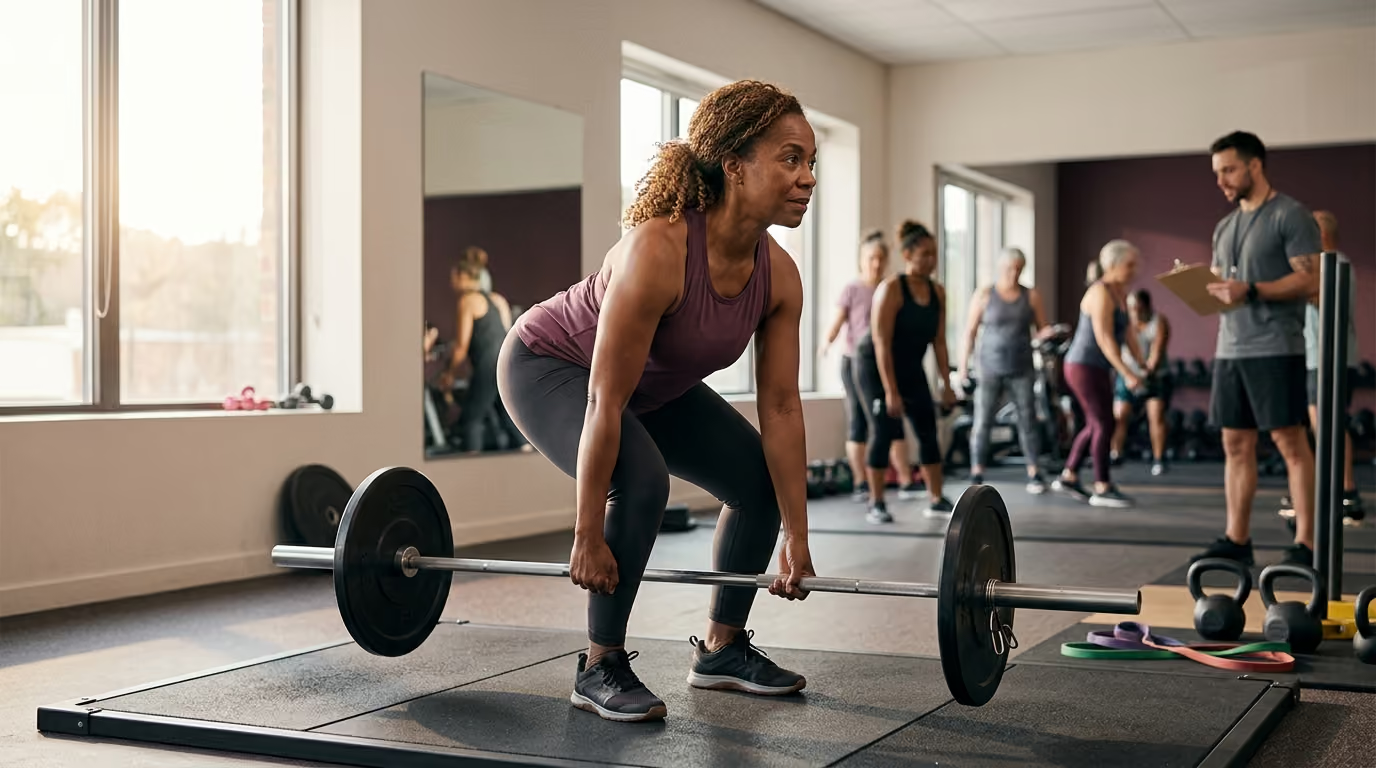

Four distinct training environments provide specific benefits for midlife adults seeking to build strength, support joint health, and maintain functional capacity safely.





Most health advice suggests that the best place to build strength is the facility with the most advanced equipment and professional supervision. Physiology shows that muscle tissue cannot detect whether a dumbbell was lifted in an expensive commercial facility or on a living room rug. The setting itself is merely a delivery mechanism for progressive mechanical tension. Analyzing where to train is not about finding a perfect venue. It is about removing the practical frictions that stop you from completing two focused sessions every week.
Women navigating midlife often face competing demands on time, shifting energy levels, and changing physical confidence. Choosing an environment requires balancing equipment needs against travel time, financial investment, privacy, and accountability. A high-end health club offers zero physiological benefit if commuting traffic prevents regular attendance. A minimal home setup can yield substantial physical gains if it allows you to consistently challenge your major muscle groups.
Understanding the strengths and drawbacks of each training environment helps you build a routine that fits your actual lifestyle. This detailed guide evaluates home training, commercial gyms, group classes, and personal coaching using current physiological research and practical midlife context.
Public health authorities provide clear targets for muscle-strengthening activity. Guidelines from the World Health Organization establish that adults should perform muscle-strengthening activities involving all major muscle groups on two or more days each week. This recommendation represents a minimum threshold for preserving physical function and metabolic health through midlife.
Exercise science demonstrates that muscle adaptation depends on applying mechanical load, managing effort, and allowing adequate recovery. Research from the American College of Sports Medicine highlights that training major muscle groups two to three days per week provides an effective balance of stimulus and recovery for general populations. The specific environment matters far less than whether the venue allows you to apply sufficient resistance and progress over time.
Supervision plays a measurable role in exercise outcomes, particularly as movement patterns or physical needs become more complex. Systematic reviews examining exercise in adults aged 60 and older show that supervised training generally produces greater improvements in physical function and well-being than unsupervised programs. A separate meta-analysis comparing supervised resistance training to self-directed programs found that direct instruction yielded superior increases in lean mass and strength. These findings confirm that guidance can be valuable, though independent training remains effective when structured with clear progression rules.
Adherence research reveals that social environment and structure heavily influence long-term participation. Studies evaluating community-based group exercise programs report average adherence rates around 69 percent. Participants frequently report that social connection, clear leadership, and structured routines make consistent attendance easier.
Metabolic research confirms that resistance training directly supports glycemic control and lean tissue preservation. Clinical trials in middle-aged and older adults show that regular strength training reduces fasting insulin, improves insulin sensitivity, and increases muscle mass. These adaptations occur across home and gym settings provided the training stimulus is sufficiently intense.
Midlife brings biological shifts that alter how your body responds to exercise and recovers from physical exertion. During the transition through perimenopause and postmenopause, declining estrogen levels influence collagen synthesis, muscle protein turnover, and bone mineral density. Estrogen plays a protective role in muscle tissue, helping maintain muscle quality and repairing muscle fibers after exertion.
As hormone levels fluctuate, women may experience gradual reductions in lean muscle mass and structural strength. This natural shift makes progressive resistance training an active necessity rather than an optional hobby. Loading the skeletal system signals bone tissue to maintain density, helping protect against osteopenia and osteoporosis.
Recovery capacity often changes during midlife. Sleep disruptions caused by night sweats or altered stress hormones can affect muscle repair and central nervous system recovery. High-stress days combined with poor sleep may require adjusting workout intensity or adding extra rest between heavy sessions.
Joint tissue and connective structures may also feel more sensitive to sudden increases in training volume. Tendons and ligaments adapt more slowly than muscle tissue to new loads. Training environments that allow you to adjust loads in small increments help prevent joint irritation while building structural resilience.
Metabolic rate gradually declines during midlife, primarily driven by the loss of metabolically active muscle tissue. Preserving lean muscle through resistance exercise helps maintain functional strength, resting energy expenditure, and glucose regulation. You can read more about managing muscle and metabolism in our detailed strength and body composition guides.
Understanding these physiological realities helps you choose a setting that supports your recovery needs. The goal is to build a strength habit that builds physical capacity without overwhelming your nervous system.
Exercise science principles must translate into practical movements that improve your daily life. Strength is not an abstract metric measured only on specialized gym machines. Functional strength refers to your ability to execute everyday physical tasks with ease, control, and resilience.
A practical midlife strength program centers on foundational movement patterns:
Training intensity determines whether your body receives a stimulus to build or preserve muscle. Exercise scientists evaluate intensity using a metric called Repetitions in Reserve, or RIR. RIR measures how many additional repetitions you could complete with sound form before reaching failure. Ending a set with two to three repetitions in reserve provides an effective stimulus for strength and muscle preservation without causing excessive exhaustion.
Working at an appropriate intensity requires honest self-assessment. Beginners often underestimate their capability, stopping a set when muscles begin to warm up rather than when they approach true exertion. Conversely, highly driven individuals may push every set to absolute failure, leading to unnecessary soreness and prolonged recovery times.
Different settings offer varying tools for calibrating effort. A personal trainer or small-group coach can observe your movement speed and help you identify true effort. In an independent home or gym setup, you must learn to track load, count repetitions, and gauge your proximity to fatigue.
Consistent training directly improves physical confidence and daily energy. Carrying groceries, lifting luggage into overhead bins, and climbing stairs without joint discomfort rely on maintaining adequate muscle reserve. You can explore further insights on maintaining confidence and capability in our articles on mental fitness and midlife confidence.
Choosing where to train requires examining four distinct options: home workouts, commercial gyms, group classes, and personal coaching. Each environment presents distinct advantages, equipment options, and logistical tradeoffs.
Home training offers unmatched convenience and complete privacy. Working out at home eliminates travel time, parking hassles, and public gym crowds. This environment suits women with demanding careers, caregiving duties, or fluid daily schedules.
Home equipment ranges from basic setups to complete home gyms:
The primary limitation of home training is the risk of under-dosing resistance. Research reviewing home-based resistance training in older adults found that while home workouts improve basic functional ability, strength gains are often modest. This limitation usually stems from light equipment, lack of exercise progression, or hesitation to push near physical limits without supervision.
To make home training effective, you need a structured plan for progressive overload. You must systematically increase weights, repetitions, or control over time rather than repeating the exact same light routine indefinitely.
Commercial gyms provide extensive equipment options that make load progression simple. Access to leg presses, cable columns, chest presses, and free weights allows you to isolate specific muscles or train around joint limitations. If a standing overhead press causes shoulder discomfort, a seated cable row or chest-supported machine press offers an immediate alternative.
Gyms also create a clear psychological boundary between home life and exercise. Leaving the house and entering a dedicated training space helps many women focus entirely on their session.
However, commercial facilities bring practical challenges:
Navigating a commercial gym successfully requires a clear written plan before you walk through the doors. Knowing exactly which exercises, weights, and machine settings you need reduces feeling lost in a busy room.
Group exercise environments vary widely in structure, size, and focus. Understanding the difference between large fitness classes and small-group strength coaching is essential for making an informed choice.
Large group classes often emphasize cardiovascular conditioning, high movement speeds, and high sweat output over progressive strength building. While these classes offer high energy and social connection, instructors cannot monitor technique closely for thirty or forty participants. Exercises may move too quickly, increasing the risk of poor mechanics or joint strain.
Small-group strength coaching typically limits attendance to four to eight participants. A coach leads the session, guides individual movement mechanics, and adjusts weights for each person. This format balances personalized instruction with the social encouragement and lower cost of a shared class.
Group settings provide excellent accountability. Having a scheduled class time and familiar workout partners makes skipping sessions much less likely.
Personal training offers the highest level of individualized direction and technical oversight. A qualified coach assesses your current movement patterns, selects appropriate starting weights, and modifies exercises around pain or previous injuries.
Personal training is particularly valuable when:
The main drawback of personal training is financial cost. Individual coaching requires a substantial recurring investment. Furthermore, working exclusively with a coach can sometimes create dependency, making clients feel incapable of training independently.
A highly effective strategy involves hiring a personal trainer for a brief six-to-eight-week period to master foundational movements, after which you transition to independent gym or home workouts.
Selecting the right setting requires an honest evaluation of your personal preferences, schedule, budget, and confidence levels. A venue that looks perfect on paper will fail if it clashes with your everyday realities.
Consider these primary evaluation dimensions before making a long-term commitment:
To help organize your decision, compare the practical features of each environment across these core dimensions:
Testing an environment before making a long-term commitment is essential. Request a single-day pass at a local gym, attend a trial session at a small-group facility, or start with minimal home equipment before investing in an elaborate setup. Visit facilities at the exact time of day you plan to train to assess crowd levels and equipment availability.
You can learn more about aligning health habits with midlife lifestyle changes by reading our guide to navigating hormonal changes or exploring the Refemina about page.
Strength training is safe and beneficial for most midlife women, but certain health conditions require thoughtful adaptations. Modifying exercises, adjusting loads, or working with a healthcare professional ensures that your training remains both safe and effective.
Osteoarthritis and joint discomfort are common in midlife. Painful joints do not mean you should stop strength training entirely. In fact, strengthening the muscles surrounding a joint reduces structural stress and improves joint stability.
Select environments that offer machine options or cable systems, which provide smooth, controlled resistance paths. Slower lifting speeds, reduced ranges of motion, and exercise substitutions allow you to challenge your muscles without irritating joint tissues.
If you have diagnosis of osteopenia or osteoporosis, loading your bones safely is a top priority. Exercises that apply axial loading through the spine and hips, such as squats, step-ups, and overhead presses, encourage bone retention.
However, individuals with low bone density should avoid rapid twisting movements under load or extreme spine flexion, such as weighted sit-ups. A structured small group or one-to-one coaching setting offers safer oversight than high-speed, unmonitored group fitness classes.
Changes in pelvic floor support can cause urinary leakage or pelvic heaviness during exertion. Proper breathing technique is critical for managing intra-abdominal pressure during heavy lifts. Exhale through the hardest part of every lift rather than holding your breath tightly.
If an exercise causes leakage or discomfort, modify the movement immediately. Choose seated or supported exercise variations, reduce the weight, or consult a pelvic health physical therapist for targeted guidance.
Consult a physician or qualified healthcare provider before starting or escalating a strength program if you experience:
Medical guidance helps define clear physical boundaries so you can train with total confidence.
While exercise science offers valuable direction, current research has distinct limitations that are important to recognize. Many historical strength training studies were conducted primarily on young, male populations. While modern research increasingly includes women, long-term studies focusing specifically on perimenopausal and postmenopausal women remain limited.
Much of the comparative data between home training and supervised facility training comes from studies in older adults aged 60 and above. While these findings offer helpful insights regarding safety and adherence, they cannot be applied directly to a 45-year-old managing career stress, sleep disruptions, and complex family schedules.
Additionally, fitness marketing frequently presents specific settings or proprietary workout programs as uniquely superior for midlife hormonal health. Current evidence does not support claims that one specific venue, brand, or workout style can singularly regulate midlife hormones.
The physiological benefits of strength training stem from applying progressive mechanical overload, managing fatigue, and maintaining consistency over months and years. Do not let commercial marketing convince you that expensive boutique facilities are necessary to achieve real physical strength.
Nutrition and recovery also play major roles in supporting your strength gains. To learn more about supporting your body through proper fueling, examine our nutrition and weight management resources.
Establishing a lasting strength habit requires matching your chosen environment to your behavioral profile. Review these practical case patterns to see how different women structure their training routines successfully.
Profile: Works extended hours, travels frequently, and has minimal free time.
Primary Venue: Home setup equipped with adjustable dumbbells and resistance bands.
Strategy: Completes two thirty-minute full-body sessions per week at home. Schedules sessions on her calendar like business meetings and utilizes bodyweight movements when traveling.
Profile: Wants to start lifting weights but feels intimidated by commercial gym spaces.
Primary Venue: Small-group coaching facility or initial personal training sessions.
Strategy: Attends a small-group strength coaching program twice weekly for two months to master movement mechanics. Builds physical confidence before deciding whether to continue or transition to independent workouts.
Profile: Struggles with self-motivation when training alone; thrives in structured social settings.
Primary Venue: Community-based strength class or small group.
Strategy: Enrolls in a twice-weekly progressive strength class with fixed schedules. The social connection and regular appointment ensure reliable attendance.
To build your personal plan, follow this systematic evaluation process:
Reevaluating your setup ensures your strength habit adapts alongside your changing lifestyle needs.
The ideal place to strength train is the setting that seamlessly fits your daily life, allows you to work hard safely, and keeps you coming back week after week.

Follow Refemina for research-led resources on hormonal change, strength, metabolism, nutrition, skin, intimate wellbeing and confidence through midlife.


Keep learning about the changes that shape energy, strength, confidence and wellbeing through midlife.
Explore Resources