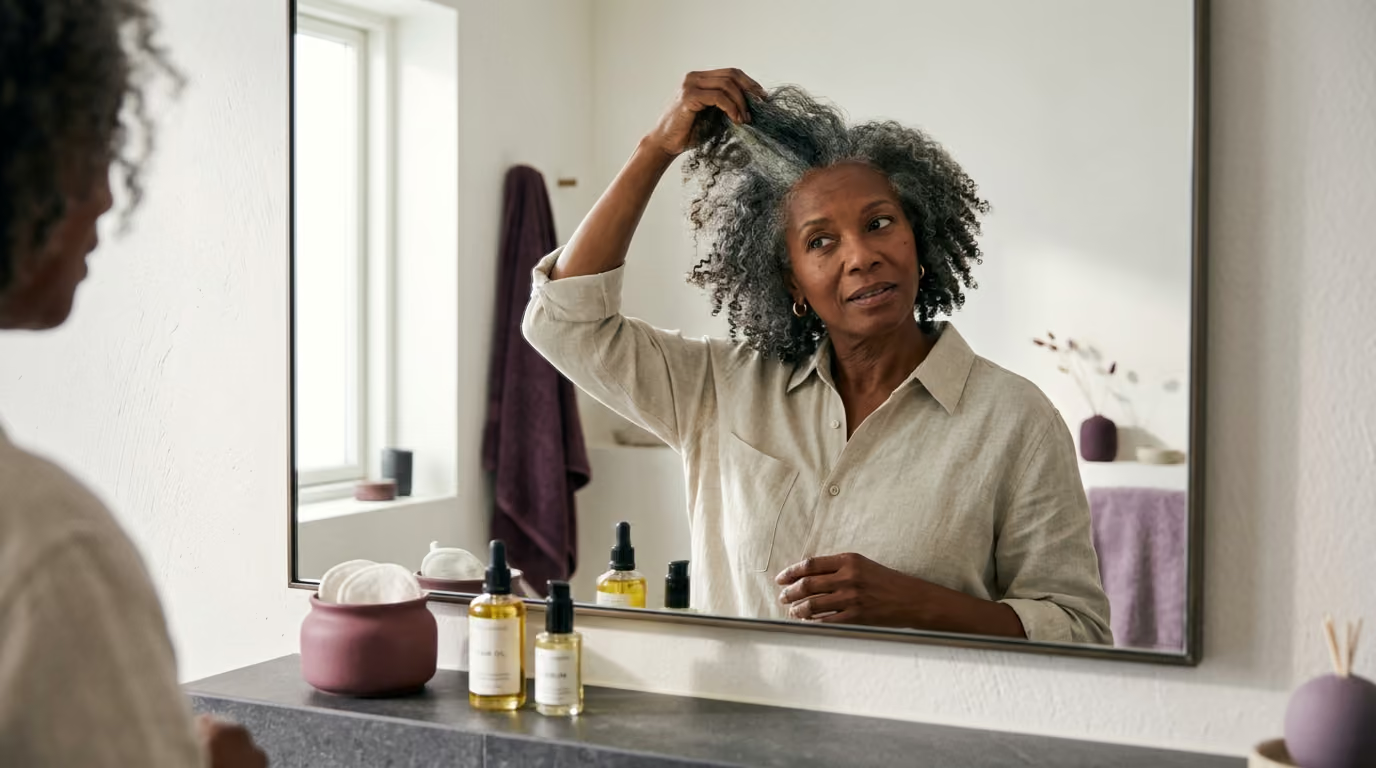

A widening part line and shrinking ponytail signal biological changes in follicle activity that alter midlife hair density, curl definition, and texture.





Most women assume that when hair feels dry, frizzy, or suddenly thin in midlife, ovarian hormones have directly altered every strand on their head. That assumption is intuitive, but it is biologically incomplete. The hair fiber you touch, brush, and style every morning is biologically inert dead tissue. It cannot respond to a drop in estrogen after it grows out of the scalp.
Midlife hair changes are not driven by a single hormonal switch. They represent an ongoing interaction between follicular biology, cumulative environmental exposure, aging fiber architecture, and scalp health. When you notice that your ponytail feels smaller or that your roots look frizzy, multiple distinct systems are interacting beneath and above the skin.
Understanding these differences protects you from panic and ineffective commercial products. Treating a weathered, porous hair shaft as if it were a hormonal follicle shutdown leads to wasted money and unnecessary frustration. Sorting out the biology of midlife hair allows you to address root health, protect fragile lengths, and make grounded choices about daily care. Explore our comprehensive resources on skin, hair and aesthetic aging to see how physical changes connect across midlife.
Hair production is governed by a dynamic cycle within the follicle. Follicles move through anagen (active growth), catagen (brief regression), and telogen (resting and shedding). Estrogen supports the duration of the anagen growth phase. When ovarian hormone production fluctuates during perimenopause and menopause, the signaling environment surrounding estrogen-sensitive follicles begins to shift.
During the menopausal transition, ovarian estrogen production falls sharply. Ovarian and adrenal androgen production declines far more gradually with age. This discrepancy creates a shift in relative hormonal balance. Even when total circulating androgens remain within standard ranges, the ratio of androgens to estrogens increases. Follicles that carry genetic sensitivity to androgens may spend less time in active growth.
Clinical research published in the British Journal of Dermatology provides critical clarity on this process. Investigators found that menopausal status directly influenced hair growth rates, anagen percentages, and hair diameter distributions, particularly across the frontal scalp. However, total hair density across the entire scalp was correlated with chronological age rather than menopausal status alone.
These findings show that midlife changes are subtle and regional rather than immediate and universal. A lower proportion of follicles in the anagen phase means slower replacement of shed strands. At the same time, a shift in diameter distribution means new hairs emerge with a finer caliber. You are not losing all your follicles overnight. Instead, the follicle is adjusting its production rhythm and strand dimensions.
To make sense of midlife texture, you must separate the living factory from the manufactured product. The follicle beneath your scalp is a living mini-organ that builds the hair shaft and provides pigment. The visible fiber extending past the scalp surface contains no living cells, blood supply, or metabolic activity. It cannot heal, regenerate, or signal back to your body.
The visible texture of your hair reflects two completely different timelines. At the scalp, you see the output of your current biological state, including hormone signaling, nutritional status, and genetic programming. Along the mid-lengths and ends, you see the physical record of everything that has happened to that fiber over the last three to six years.
Hair fibers undergo natural mechanical changes as we age. Research demonstrates that female hair diameter increases through young adulthood, reaches its peak around the early forties, and begins a gradual decline thereafter. Thinner fibers possess lower cross-sectional area and reduced internal cortex mass. Because of this structural shift, thinner fibers bend, tangle, and snap under far less physical tension than thicker strands.
The protective outer layer of the hair fiber is the cuticle, composed of overlapping scales. Over years of ultraviolet light exposure, shampooing, blow-drying, and chemical coloring, these cuticle scales lift, chip, and erode. When cuticle layers wear away, moisture escapes rapidly and environmental humidity penetrates easily. A rough, porous feel along the ends is primarily a record of cumulative fiber wear, not an active hormonal crisis.
Understanding this division clarifies daily hair observations. If your hair feels coarse and unmanageable near the ends while growing in soft and fine at the roots, the issue is cuticle degradation along older lengths. Conversely, if your scalp is increasingly visible under bright light while your ends remain intact, follicular dynamics require attention. Learn more about our evidence-led approach on the Refemina about page.
Many women use the word "thinning" to describe several completely distinct physical processes. True density loss refers to fewer active hairs per square centimeter of scalp. Caliber reduction means individual hairs grow with a smaller diameter. Breakage means strands snap off above the scalp level. All three issues reduce ponytail volume, but their biological origins are entirely different.
Female Pattern Hair Loss, known clinically as FPHL, is the most common nonscarring hair loss condition in midlife women. It is driven by follicular miniaturization, where susceptible follicles produce progressively finer, shorter, and less visible hairs over successive growth cycles. Unlike male pattern baldness, FPHL typically preserves the frontal hairline while causing diffuse thinning across the central part and crown.
A cross-sectional study evaluating 178 postmenopausal women found that 52.2% presented with measurable Female Pattern Hair Loss. Among those affected, 73.2% exhibited mild Ludwig grade I thinning, 22.6% showed moderate grade II thinning, and only 4.3% presented with severe grade III involvement. The prevalence of FPHL rose alongside chronological age and the number of years since the final menstrual period.
Miniaturization must be distinguished from telogen effluvium, which is an acute, diffuse shedding event. In telogen effluvium, an abrupt physiological stressor pushes a high percentage of follicles out of anagen and into the telogen resting phase. Roughly two to four months later, these hairs shed in large quantities across the entire head.
Telogen shedding can occur after severe illness, rapid weight changes, major surgery, thyroid dysfunction, or extreme psychological stress. It is usually temporary and resolves once the underlying trigger is addressed. Miniaturization, by contrast, develops slowly over years without sudden handfuls of hair in the shower. Paying attention to the location and timeline of density loss is the first step toward accurate evaluation.
Midlife hair changes involve more than just density. Women frequently report unexpected wave patterns, relentless frizz, changes in greasiness, and coarse silver strands. Each of these concerns has a distinct biological and physical explanation.
Many women report that straight hair becomes wavy during perimenopause, or that lifelong curls suddenly lose their definition. While personal reports are widespread, clinical studies isolating menopause as the direct cause of curl pattern changes remain limited. Direct research proving that estrogen changes follicle curvature is not yet established.
Plausible physical mechanisms explain why your curl pattern appears to change:
Frizz is not a medical diagnosis. It is the visible consequence of irregular fiber alignment, surface friction, and uneven moisture exchange. When the protective cuticle scales are worn down by age, heat, and hair dye, the exposed cortex absorbs water vapor from humid air. This absorption causes individual strands to swell unevenly and buckle outward from the hair mass.
Broken ends and short, newly emerging hairs also create a frizzy appearance. Because these shorter fibers do not reach the full length of your hairstyle, they stand away from the main surface. Laboratory testing demonstrates that chemical processing substantially reduces hair fiber strength, lowering breaking force by up to 45% in damaged samples. When fragile fibers break mid-shaft, the remaining fragments protrude as surface frizz.
Greying occurs when follicular melanocytes gradually lose their ability to produce melanin pigment for the growing hair shaft. Research confirms that this process is driven by oxidative stress, melanocyte apoptosis, and the depletion of melanocyte stem cells in the hair bulb. Hydrogen peroxide accumulation inside the follicle damages pigment production over time.
A common belief is that grey hairs are inherently coarser and thicker than pigmented hairs. In reality, fiber diameter varies widely among grey strands. Grey hairs often feel stiffer because the absence of melanin alters internal protein organization, and unpigmented fibers are frequently drier due to concurrent reductions in lipid production. The contrast between bright, light-reflecting silver hairs and darker surrounding strands also makes individual grey hairs appear more prominent.
Perceptions of scalp oiliness often shift during midlife. Some women find their scalp becomes greasy within a day of washing, while others experience persistent dryness and flaking. While one postmenopausal study identified higher scalp sebum as a factor associated with FPHL, menopause does not automatically increase oil production across all women.
Sebum output naturally decreases as estrogen and systemic hormone levels fall with age. However, when individual hair fibers become finer or overall density decreases, there is less total surface area available to absorb normal oil output. As a result, even reduced amounts of sebum can quickly coat fine roots, making the hair look limp and greasy. At the same time, older mid-lengths remain starved of moisture, creating an oily scalp paired with parched ends.
Midlife hair concerns rarely appear in isolation. They present as overlapping combinations of biological shifts, daily habits, and past chemical treatments. Here are six common patterns and how to interpret them accurately.
A 52-year-old woman notices that her central part looks broader in overhead bathroom lighting, though her ponytail thickness feels relatively normal. Her hair lengths are soft, and she does not see clumps of hair shedding in the drain.
This presentation aligns with early Female Pattern Hair Loss. Follicles along the vertex and central line are experiencing gradual miniaturization, producing finer hairs that expose more scalp. The solution focuses on scalp-level evaluation and targeted medical therapies rather than heavy conditioning masks.
A 48-year-old woman observes that her ponytail circumference has dropped by a third over two years. When examining her scalp, her part line is tight and dense, but she notices thousands of short, jagged hairs along the mid-lengths.
This pattern indicates mechanical and chemical breakage rather than follicular failure. Peak fiber diameter naturally declines in the late forties, making strands less resilient to daily heat styling, aggressive brushing, and bleaching. The follicles are producing adequate hair, but the fragile shafts are snapping before reaching full length.
A 55-year-old woman recovers from a severe viral illness paired with dramatic weight loss. Three months later, handfuls of hair come out during washing, leaving hair all over her clothes and floor.
This scenario represents classic telogen effluvium. The systemic shock synchronized thousands of growing follicles into the resting phase simultaneously. Because telogen lasts roughly 100 days, the shedding appears months after the original event. Reassurance, nutritional support, and time are the primary management tools, as the follicles generally resume normal cycling on their own.
A 50-year-old woman finds her roots look greasy and flat by noon, while her ends are coarse, tangled, and snapping off during brushing.
This mixed presentation stems from structural caliber loss combined with historical chemical wear. Fine roots sit flat against the scalp and accumulate normal sebum rapidly. Meanwhile, the porous, color-treated ends have suffered cuticle erosion and cannot retain moisture. Washing the scalp with clarifying cleansers while applying rich emollient conditioners strictly to the lower lengths resolves the mechanical mismatch.
A 53-year-old woman feels her hair turned silver over the span of a single stressful month.
Hair fibers already outside the scalp cannot lose their existing pigment. What feels like an overnight transformation is usually the emergence of unpigmented roots against colored lengths, or diffuse shedding of darker telogen hairs that leaves lighter hairs more visible. Understanding this timeline relieves the fear that acute stress permanently altered existing strands.
A 54-year-old woman notices several coarse, dark hairs on her chin while noticing that the hair around her temples is becoming finer.
This combination reflects the changing estrogen-androgen ratio in midlife skin. As estrogen declines, relative androgen signaling can stimulate coarse terminal hair growth in androgen-responsive facial follicles while prompting miniaturization in susceptible scalp follicles. A comprehensive medical review helps assess whether this shift is part of standard midlife biology or indicative of wider metabolic and endocrine changes.
Managing midlife hair requires targeted care for both the scalp and the hair shaft. You cannot change follicle genetics with a salon shampoo, and you cannot repair broken dead fibers with a hormone pill. A structured, evidence-aligned routine focuses on mechanical preservation, scalp health, and realistic styling modifications.
The scalp is the biological ground supporting follicular function. Keeping it clean and free from inflammatory scale is necessary for healthy hair growth:
Because midlife hair fibers are narrower and possess lower tensile strength, physical handling must be adjusted to prevent excessive breakage:
Cumulative heat and chemical damage strip the natural lipid layer from hair cuticles, accelerating midlife texture degradation:
Embracing or managing aesthetic changes works best when aligned with fiber physics:
While many midlife hair shifts represent standard physiological adjustments, some patterns indicate underlying medical conditions that require clinical evaluation. Dismissing significant hair loss as an inevitable part of menopause can delay necessary treatment for treatable systemic disorders.
Consult a board-certified dermatologist or primary care physician if you observe any of the following symptoms:
A thorough medical workup should evaluate potential contributors to hair shedding. Clinicians often assess complete blood counts, ferritin and iron parameters, thyroid-stimulating hormone (TSH), vitamin D levels, and relevant androgen markers.
Routine iron supplementation should not be started without confirmed laboratory deficiency. Research indicates that iron deficiency is not statistically more common in women with FPHL than in unaffected controls. Indiscriminate iron intake carries risks of iron overload and organ toxicity. For a wider perspective on metabolic health, review our articles on nutrition and weight management.
The midlife beauty and wellness market is saturated with products promising to reverse thinning, restore youthful texture, and cure hormonal hair loss. Separating verified science from marketing rhetoric helps you protect your time, emotional energy, and financial resources.
We can categorize midlife hair claims into three distinct levels of scientific confidence:
Commercial supplements frequently advertise biotin, collagen, and proprietary herbal blends as essential fixes for midlife hair. Unless a true clinical deficiency exists, high-dose biotin does not regrow hair and can dangerously interfere with critical laboratory tests, including cardiac troponin and thyroid assays. Approach product claims with healthy skepticism and ground your decisions in verified biological facts. Find more evidence-based guides across our library of midlife resources.
Midlife hair changes are a natural physical evolution that can be understood, managed, and navigated with clarity, scientific evidence, and steady confidence.

Follow Refemina for research-led resources on hormonal change, strength, metabolism, nutrition, skin, intimate wellbeing and confidence through midlife.


Keep learning about the changes that shape energy, strength, confidence and wellbeing through midlife.
Explore Resources