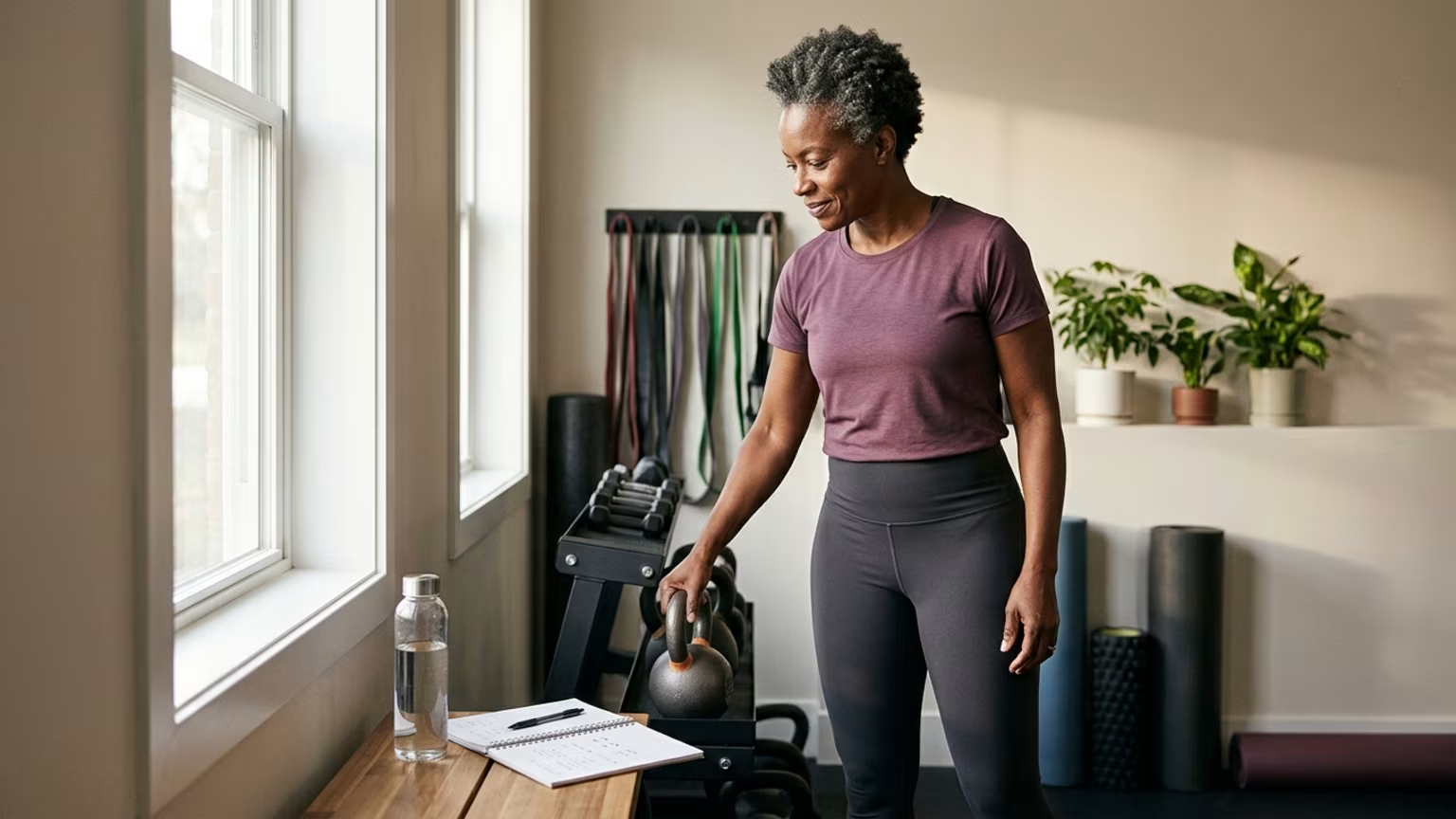

A 2026 synthesis of clinical trials outlines how midlife women can build muscle and reduce fat simultaneously through targeted resistance training and protein.





On September 16, 2026, the publication Body Muscle Matters updated a synthesis of clinical trials indicating that postmenopausal and overweight women can simultaneously reduce fat mass and build skeletal muscle through targeted resistance training and protein protocols.
For decades, standard medical guidance framed midlife body changes largely around simple scale-weight loss. Clinicians frequently advised women to manage menopausal physical shifts through basic calorie restriction, which often ignored the loss of critical lean muscle. The prevailing clinical view assumed that body recomposition was difficult or impossible for older adults. The new synthesis challenges this approach by positioning simultaneous fat reduction and muscle gain as a practical goal for midlife women.
The updated research synthesis identifies several specific findings and updated protocols for women seeking to change their body composition. The findings highlight that resistance training drives the physical adaptations necessary for building lean tissue.
While the updated synthesis offers actionable guidance, the underlying evidence base contains several notable gaps. The primary publication describes the overweight-women and postmenopausal-women trials without providing enough bibliographic or numerical information to independently verify them. The article omits the exact sample sizes, participant ages, comparison groups, and statistical values for these specific populations. Readers should treat the recommendations as a useful practical interpretation rather than an independently validated clinical protocol.
The broader evidence base clarifies that protein alone is not a complete solution for midlife women. A summary of the 12-week study involving 55 healthy postmenopausal women demonstrates this point clearly. The researchers reported that the training groups improved their physical strength significantly. Consuming additional protein without participating in a training program did not improve body composition.
Combining protein supplementation with training was not superior to training alone for the headline outcomes. This reinforces that lifting weights provides the primary stimulus for muscular adaptation. The research regarding optimal protein dosages also presents conflicting numbers. The safest approach is to view the 1.62 grams per kilogram plateau identified in the 49-study meta-analysis as a sensible ceiling for most healthy adults.
Protein intake is a central component of the updated recommendations. The synthesis suggests a target of 1.8 to 2.4 grams of protein per kilogram of body weight per day for adults over 40. The available meta-analytic evidence points to a muscle-gain plateau near 1.62 grams per kilogram per day in healthy adults. This suggests that progressively higher protein intake does not necessarily produce proportionally greater muscle gain once that threshold is met.
Midlife women can treat the higher range as a practical strategy for specific circumstances rather than a universally required daily dose. The 2026 systematic review and meta-analysis involved 1,863 healthy adults. It found that protein supplementation during resistance training increased fat-free mass and physical strength. This broad analysis provides stronger quantitative support for the relationship between protein and strength training than the primary article's unidentified female trials do.
The evidence requires careful interpretation regarding extreme protein targets. One trial involving 30 resistance-trained adults used a very high intake of approximately 2.5 grams per kilogram per day alongside a 250-kilocalorie daily deficit. In that 10-week trial, the moderate-deficit group lost 2.94 kilograms of fat mass while gaining 1.04 kilograms of fat-free mass. The isocaloric high-protein group lost 1.41 kilograms of fat mass and gained 0.97 kilograms of fat-free mass.
Because the participants had a mean age of 23 years, these specific results should not be treated as direct evidence for women navigating perimenopause and postmenopause. Readers should approach some age-specific claims in the primary article with caution. The publication describes older adults as needing both approximately 40 percent and approximately 68 percent more protein per dose. The article contains these internally inconsistent protein-aging claims within its own summary.
Women can adjust their total intake within a broad range based on their individual dietary reasons or periods of energy restriction. Distributing protein across multiple meals creates a sustainable approach to daily nutrition. Consulting a clinician is advisable before attempting sustained high-protein diets, especially for individuals with kidney disease or other medical conditions.
The evidence strongly supports resistance training as the central intervention for changing midlife body composition. The synthesis recommends completing three to four weekly resistance-training sessions. Trainees are advised to work generally within one to three repetitions in reserve. Progression involves adding load, increasing repetitions, completing more sets, or improving technique over time.
Broader research highlights how resistance training benefits postmenopausal women beyond simple muscle growth. The LIFTMOR randomized trial evaluated postmenopausal participants with low to very low bone mass. These women were assigned to twice-weekly supervised high-intensity progressive resistance training with impact loading for eight months. The results support the broader relevance of progressive resistance training for skeletal integrity and physical function in midlife and older women.
A separate summary notes that resistance training can improve body composition during calorie restriction. This holds true even when scale-weight loss is not greater than the weight lost through dieting alone. This distinction is particularly important for women whose body weight may remain stable while their waist circumference, strength, or lean mass changes. Resistance exercise provides a stimulus that protects lean tissue when overall energy intake is reduced.
Recovery is an equally critical component of the recomposition process. Muscles require adequate rest between training sessions to repair tissue and adapt to new physical demands. The recommendation for three to four weekly sessions leaves ample time for recovery on the alternating days. Overtraining can stall progress and increase the risk of injury, especially when combined with a calorie deficit.
The updated protocol recommends a moderate energy restriction of approximately 200 to 300 kilocalories per day for intermediate trainees. This creates a mild shortage of energy that encourages fat loss without drastically impairing muscle retention. A severe calorie deficit frequently accelerates the loss of lean tissue and compromises physical strength. A moderate approach allows women to continue lifting effectively while gradually reducing their body-fat percentage.
The research landscape for postmenopausal women also includes investigations into creatine supplementation. A 2026 review reported modest lean-mass and lower-body-strength benefits when creatine was paired with resistance training. These benefits were particularly notable at doses of at least 5 grams per day. However, this evidence concerns creatine supplementation rather than protein intake alone, meaning supplements are not strictly required for body recomposition.
Evaluating changes in body composition requires looking beyond the traditional bathroom scale. The research identifies simultaneous fat-mass reduction and lean-muscle gain as the true markers of recomposition. Body weight alone cannot distinguish between a loss of fat and a loss of muscle. Women can evaluate their progress more accurately using strength records, waist measurements, and changes in clothing fit.
It is helpful to understand the limitations of short-term physiological measurements. Terms like skeletal-muscle mass, lean mass, and fat-free mass are not entirely interchangeable. Changes in hydration levels, stored glycogen, and specific measurement techniques can all influence apparent lean-mass results. Brief periods of training should not be interpreted as absolute proof of large, durable muscle gains.
Developing a long-term perspective helps women navigate the natural fluctuations of midlife. Muscular adaptations occur gradually over months of consistent effort. Expecting immediate visible changes often leads to unnecessary frustration and premature abandonment of the training program. Measuring success by physical capability, such as lifting heavier weights or recovering faster between sets, provides immediate positive feedback while the underlying body composition shifts.
Translating these findings into a sustainable routine requires patience and a clear perspective. The evidence does not establish that every postmenopausal woman will simultaneously lose fat and gain muscle. The trials involved different populations, varying intervention durations, distinct protein intakes, and multiple measurement methods. Rather than chasing a perfect physiological outcome, midlife women can focus on practical lifestyle levers.
Going forward, clinical practice will likely shift from prescribing basic scale-weight loss for midlife women to prioritizing progressive resistance training protocols that actively protect and build lean muscle.
Applying specific protein targets and progressive resistance training protocols to a weekly schedule involves careful planning, but setting realistic physical goals takes less guesswork with Refemina translating the clinical evidence. The publication addresses confusion about which midlife changes are hormonal and which have multiple causes, equipping readers to improve strength and body composition without anti-aging pressure.

Follow Refemina for research-led insights on menopause, strength, metabolism, nutrition, skin, intimacy and confidence through midlife. New articles turn complex topics into clear, useful context.





Keep learning about the changes that shape energy, strength, confidence and wellbeing through midlife.
Explore Resources