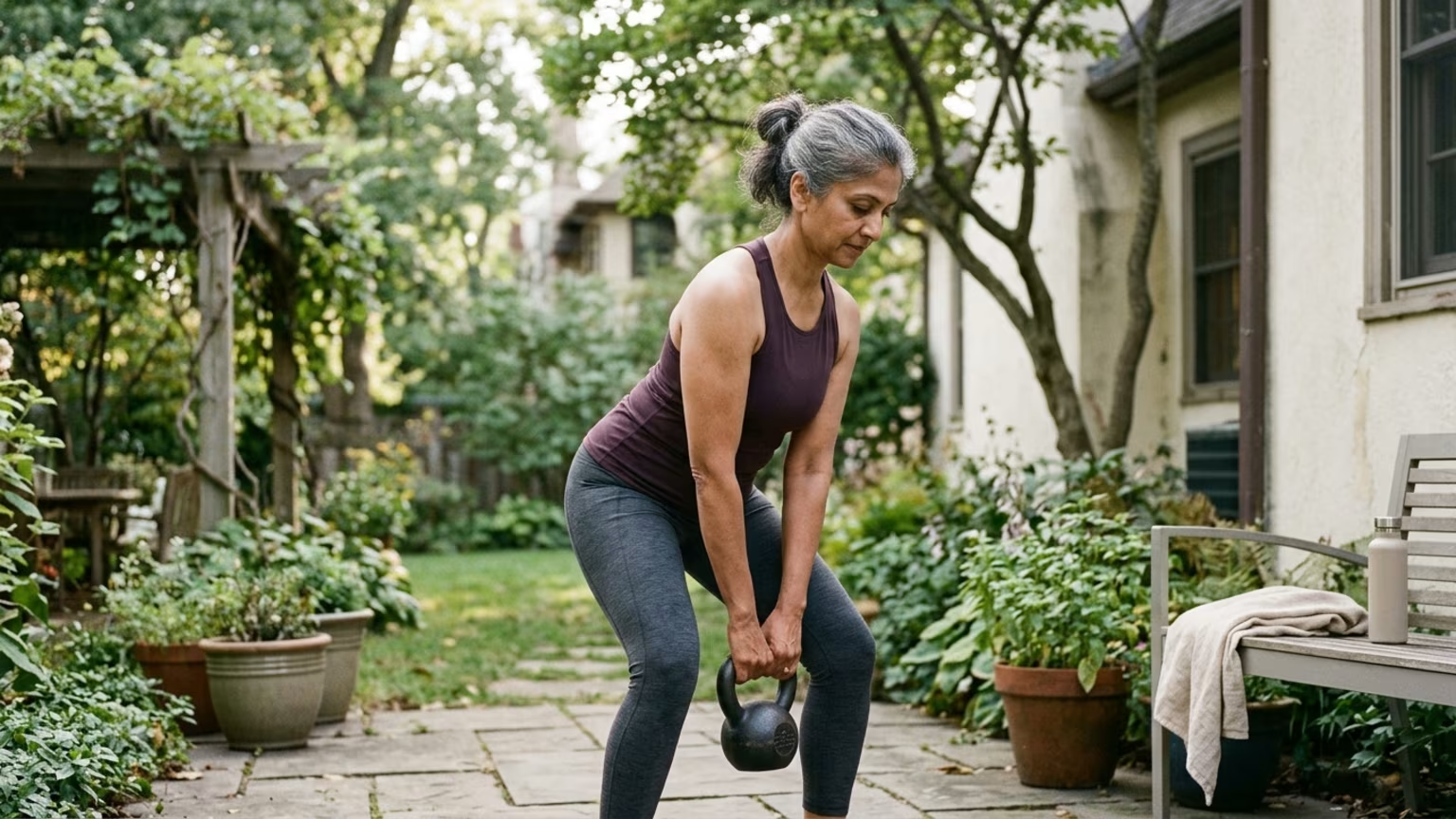

A closer look at Michelle Heaton’s six strength exercises, the resistance-training evidence and the planning details a workout profile leaves open.





On October 9, 2026, Women’s Health UK published Kate Cheng’s profile of singer Michelle Heaton and six exercises from her regular training routine. The feature was updated on October 14, 2026.
The clinical backdrop predates this profile. The British Geriatrics Society points back to a 2022 UK consensus statement that supported progressive resistance and impact training for bone health. Its discussion also places exercise in the context of falls prevention.
That existing approach gives the feature a useful frame: exercise choices belong within a wider discussion of health and physical capability. A recognisable routine can make that discussion more concrete. It does not have to introduce a new medical recommendation to be worth examining.
For midlife readers, the distinction matters. The question is not whether a public figure has found the definitive workout after 40. It is how her exercise choices relate to established evidence and the planning decisions that make training suitable for an individual.
Cheng’s article describes a routine combining upper- and lower-body strength movements with assault-bike cardio intervals. The six named exercises are:
Together, these are the movements the feature presents under the heading of full-body strength. Their names offer a concrete starting point for discussing exercise choices. Understanding a movement’s place in someone’s training is a different task from simply collecting exercises that look appealing.
Heaton’s explanation is personal. As reported by Women’s Health UK, she sees lifting weights after 40 as important for maintaining muscle mass and supporting metabolism and bone health. Her comments were originally shared on Instagram.
She also associates strength training with posture and balance, alongside joint health. Her comments extend to stress and mood. She places the routine within a broader interest in physical health and quality of life.
That is a worthwhile editorial frame for midlife exercise. Strength can be discussed in terms of what a woman wants her body to do, rather than only how she wants it to look. Appearance remains a legitimate interest, but it does not need to set the purpose of every workout.
The useful distinction is between a person explaining why she trains and research measuring what training achieves. Both can contribute to a readable fitness feature. They carry different kinds of authority.
Separate secondary coverage of a 2024 review describes a systematic review and meta-analysis of 12 studies in healthy postmenopausal women. It reports improvements in measures of muscle strength and physical capacity with resistance training.
That evidence addresses a broader question than which movements appear in Heaton’s session. It concerns resistance training and measured outcomes in the population studied. The profile supplies an example of exercise selection, while the review coverage supplies a research context for discussing strength and function.
Keeping those roles separate makes the story more useful. A personal account can make training feel tangible. Research helps establish which outcomes have actually been examined, rather than leaving every benefit attached to the appeal of the person sharing the workout.
It also keeps the focus on outcomes that matter beyond a workout’s presentation. Muscle strength and physical capacity are the reported measures here. They deserve attention in their own right, without being translated automatically into a promise about weight or appearance.
The Women’s Health UK feature is a practical profile, not a clinical study testing these six exercises as a programme. It does not include an evaluation by a named clinician or exercise-science expert. Heaton’s broader health-benefit statements remain her attributed rationale rather than independently assessed findings about this routine.
The article supplies technique cues such as bracing the core, keeping the back neutral and controlling movement. It does not specify sets or repetitions, loads or rest periods. Frequency and progression are also absent, along with recovery guidance and fitness-level adaptations.
Access is another boundary. Several exercises require gym equipment, including weights and a bench. Others involve a barbell with a landmine attachment or secure corner, plus a cable machine. The movements may need adaptation for someone’s experience or mobility and health circumstances.
The review’s participants were healthy postmenopausal women. Its findings should not automatically be transferred to every woman in perimenopause or to people with relevant medical conditions. Nor do they establish that Heaton’s exact selection produces the reported outcomes or confirms her comments about metabolism.
These distinctions leave room for useful exercise ideas without presenting the feature as a complete or individually suitable training prescription.
The practical next step is to use the exercise names as a starting point for discussing suitable movements. Current training experience and available equipment belong in that discussion. So do mobility and health circumstances.
Where those decisions are personal, a qualified exercise professional or clinician can help address appropriate exercise selection and adaptations. Questions about load and training volume belong there too, together with frequency and progression. These are planning decisions to resolve deliberately rather than guess from a profile.
Controlled technique is the clearest practical emphasis supplied by the feature. Its cues direct attention to how a movement is performed. That makes a more useful discussion point than treating completion of every item on the list as the main objective.
Equipment also deserves a practical rather than aspirational reading. A cable machine or landmine setup is part of what this particular routine uses. Choosing exercise need not become a test of whether a reader can recreate someone else’s gym setup. The relevant question is which movements and equipment fit her current situation.
For readers seeking a wider starting point, Refemina’s guide to building a foundation in resistance exercise offers related reading. Its resource on understanding movement choices and technique provides another way to approach the subject beyond a single exercise list.
Purpose matters too. Strength and physical function are legitimate aims, whether or not changing body weight is a priority. A routine can be interesting because it gives someone language for discussing training, not because it promises a different body shape.
There is also no need to assign every change in muscle or energy to menopause. This feature supports a conversation about exercise, not a single-cause explanation of midlife bodies. Keeping that distinction clear leaves more room for a woman’s wider health and circumstances.
The most constructive reading is therefore neither imitation nor dismissal. Heaton’s choices can prompt useful questions about resistance training. The answers should come from the evidence relevant to the goal and from planning that fits the person, rather than from the visibility of the routine alone.
This feature can make resistance-training discussions more concrete, while clinical decisions continue to rest on established evidence and individual circumstances.
A shared exercise list can lead to broader questions about changing muscle and body composition; Refemina addresses that next stage through research-led coverage of strength and nutrition. It helps readers make sense of muscle and weight changes through a wider account of midlife health, with room for confidence and realism rather than pressure to buy a solution.

Follow Refemina for research-led insights on menopause, strength, metabolism, nutrition, skin, intimacy and confidence through midlife. New articles turn complex topics into clear, useful context.


Keep learning about the changes that shape energy, strength, confidence and wellbeing through midlife.
Explore Resources