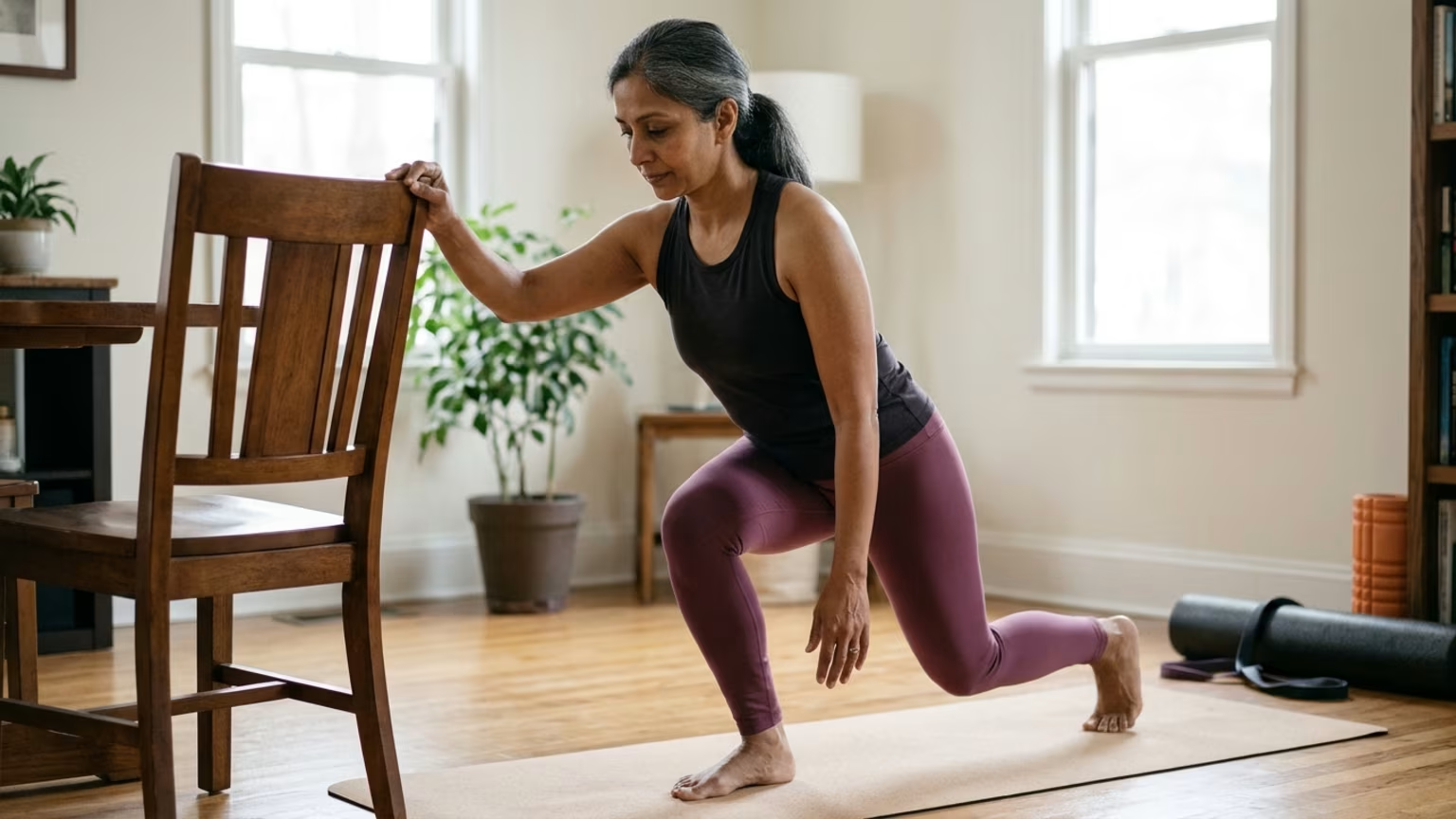

A closer look at Suzi Jalowsky’s five-move leg routine, her reported workout format and the limits of its health claims.





On September 30, 2026, Women’s Health UK profiled 60-year-old fitness creator Suzi Jalowsky and outlined her five-exercise lower-body routine. The workout uses one dumbbell and centres on slow, controlled movement.
This publication did not overturn an earlier medical consensus or announce a change in standard care. It presented a woman’s own approach to lower-body training. That distinction matters when a fitness story reaches readers looking for answers about strength during midlife.
A personal routine answers a narrow question: what does this person do? A clinical recommendation must answer a broader one: what does the evidence support for a particular person and purpose? Reading the profile in the first category preserves its practical value without asking it to carry medical authority.
There is also value in the representation itself. Here is a woman at 60 demonstrating strength work rather than being portrayed only through age-related limitations. Her example offers a way into the subject without making her age or performance a benchmark for someone else.
According to Women’s Health UK, Jalowsky’s routine contains the following exercises:
The practical attraction is a defined set of movements with a limited equipment list. Rather than presenting an open-ended collection of exercises, the profile gives readers a concrete example to examine. Its simplicity is about the format and equipment, not a claim that every movement will feel simple to every person.
The profile attributes the workout structure to Jalowsky’s own Instagram guidance:
These details make the example specific. They describe how Jalowsky organises this workout rather than establishing an ideal prescription for all women in midlife.
For readers comparing exercise content online, attribution is useful. “Jalowsky recommends this format” identifies the person making the recommendation and keeps the scope clear. It is a more accurate description than presenting the same numbers as a research-backed rule for women of a particular age.
Women’s Health UK reports that Jalowsky uses a 13 kg dumbbell. The same article advises people new to strength training to begin with bodyweight before progressing to weights.
Those details belong together. Reporting the dumbbell weight alone would leave out the publication’s starting-point advice and could make a personal equipment choice look like a requirement.
The useful editorial comparison is therefore the approach rather than the load. A reader does not need to match Jalowsky’s dumbbell to understand the routine’s emphasis on controlled movement. Nor does the profile establish that reaching her weight should be anyone else’s training goal.
This is a helpful distinction when viewing a capable person demonstrate an exercise. What is visible is her chosen version of the movement. The reader’s own starting point remains a separate question.
For the single-leg Romanian deadlift, the article describes keeping the planted knee softly bent and hinging at the hips. It also says the toes of the raised leg may remain lightly touching the floor for balance.
That detail makes the description more useful than the exercise name alone. The reported version does not insist that the lifted foot must stay completely off the ground. Light toe contact is presented as an available adaptation within the movement.
The broader message is about interpreting a demonstration rather than copying its appearance exactly. In this profile, the balance option and the emphasis on control are part of the example too. They deserve attention alongside the dumbbell and repetition count.
The profile is not a trial of this workout. It does not establish that the exact combination produces weight loss or changes metabolism. It also does not test whether the routine prevents falls or improves cognition.
Women’s Health UK discusses associations between leg strength and cognitive outcomes. However, the coverage does not identify the underlying studies or researchers well enough to assess those findings independently. Those claims should not become a promise about Jalowsky’s exercises.
The article describes Jalowsky as a fitness creator but does not state that she holds formal fitness qualifications. Her workout guidance should be attributed to her rather than presented as independent clinical expertise.
There are also clear boundaries to the routine itself. Its exercise list contains no upper-body movements, so it is not a complete strength-training programme. The coverage does not establish suitability for every fitness level or health condition, and it does not test a menopause-specific benefit.
These limits define the appropriate use of the story: a practical example of home-friendly lower-body training. They do not make the example worthless. They keep its appeal separate from outcomes that have not been demonstrated.
The clearest practical takeaway is to separate three things: the exercise selection, the creator’s chosen format and the reader’s individual needs. They appear together in a workout story but are not interchangeable.
For someone unfamiliar with strength training, the publication’s bodyweight starting point is the relevant reported guidance. For decisions shaped by a health condition or concerns about balance and movement, a qualified clinician or exercise professional is the appropriate source of individual advice. The article need not be treated as a self-contained plan.
A useful conversation could begin with the routine itself: which movements interest the person and what help would make them understandable? That keeps attention on the person’s goals rather than on reproducing a creator’s performance.
For wider context, Refemina’s coverage of making sense of muscle-building research during menopause addresses a different question from this personal workout profile. Its discussion of training progression beyond the headline weight also provides a related editorial perspective.
The distinction is worth retaining. A demonstration can make strength training feel concrete. Research interpretation and personal guidance do different work. Readers are better served when those roles remain visible rather than being collapsed into a single confident fitness claim.
The useful next step for clinical practice is to turn this concrete example into a conversation about each woman’s strength goals and the support those goals require.
Choosing which parts of a creator’s leg routine are relevant is a starting decision; Refemina brings research-led context to the wider questions about a changing midlife body. For women noticing shifts in strength or body composition, its coverage connects hormonal change with training and nutrition to support clearer understanding without reducing every concern to weight or a single cause.

Follow Refemina for research-led insights on menopause, strength, metabolism, nutrition, skin, intimacy and confidence through midlife. New articles turn complex topics into clear, useful context.


Keep learning about the changes that shape energy, strength, confidence and wellbeing through midlife.
Explore Resources